Thank you for Shopping with us at Cottage Craft Works, Celebrating 20 Years in Business

Article

How to Choose a Push Reel Mower | Size, Grass & Cutting Height

Primary Question: What should I look for when buying a push reel mower?

Consider lawn size, cutting width, desired grass height, mowing frequency, terrain, debris, mower construction, replacement-parts availability, and the physical effort required to push the mower.
How to Choose a Push Reel Mower | Size, Grass & Cutting Height

How to Choose a Push Reel Mower

A push reel mower can provide decades of simple lawn maintenance, but it isn't the right mower for every yard, person, or budget.

Before purchasing one, consider lawn size, mowing frequency, grass height, terrain, debris, desired cutting height, mower width, mower construction, and the physical effort required.

Who Is a Push Reel Mower For?

A manual reel mower is particularly well-suited for someone who regularly maintains a lawn and wants mechanically simple equipment without a gasoline engine or battery-powered cutting system.

Reel mowers are especially practical for small yards and limited storage areas. Many can even be hung on a garage wall when not in use.

The mower is powered entirely by the person walking behind it.

That simplicity eliminates the need for gasoline, spark plugs, engine oil, batteries, charging, and many of the maintenance requirements associated with powered lawn equipment.

There is a trade-off. You provide the power, and reel mowers still require periodic maintenance. This includes proper bedknife adjustment, sharpening when needed, cleaning, and lubrication of the internal drive mechanisms.

Consider Your Lawn Size

An 18-inch reel mower is maneuverable and works well around landscaping, gardens, and smaller lawns. Its narrower reel also creates less resistance when pushing, particularly when using a grass catcher.

A 21-inch mower covers more ground with each pass and can reduce the number of passes required to mow a larger lawn. However, the wider reel requires somewhat more effort to push, especially when using a grass catcher.

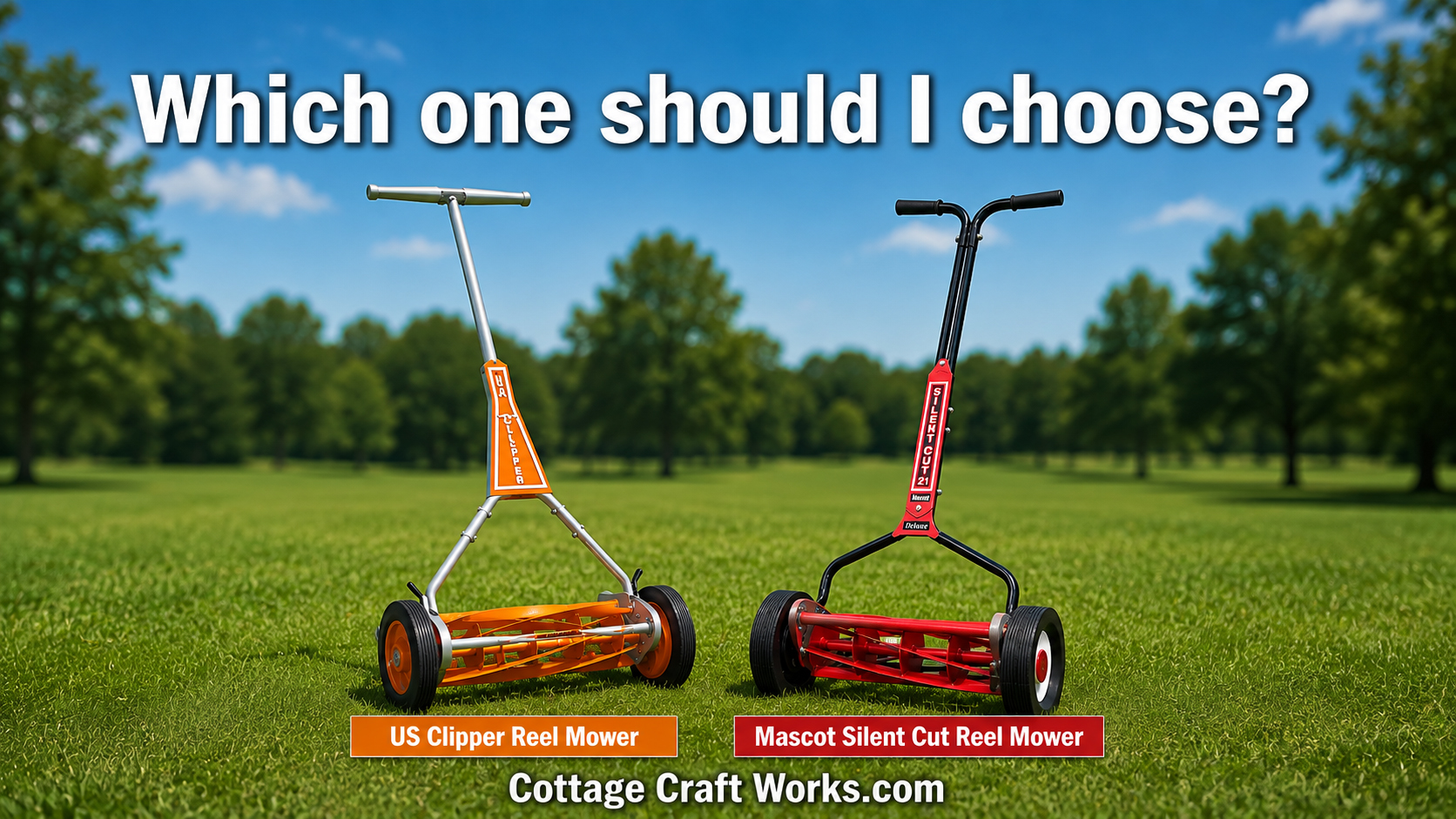
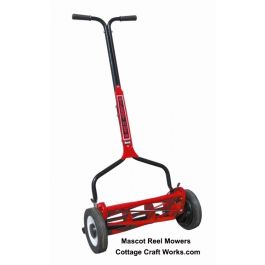
Cottage Craft Works offers Mascot push reel mowers as well as premium USA-made Clipper reel mowers.

Both mower designs have strong roots in Amish communities where simple, repairable, human-powered equipment continues to be used for everyday lawn maintenance. Their construction is much closer to that of the heavy-duty equipment commonly produced decades ago than to that of many lightweight consumer reel mowers sold today.

When comparing a Mascot or Clipper to a reel mower from a large-box store or online retailer, look beyond the purchase price. Examine the thickness of the metal, wheel construction, reel assembly, bedknife, adjustment mechanisms, bearings, gears, and amount of plastic used throughout the mower.

Consider How Often You Mow

Reel mowers are maintenance mowers.

They perform best when short-grass varieties are cut regularly, generally between approximately ½ inch and 3 inches, rather than being allowed to become severely overgrown.

A reel mower can bog down in deep, lush grass.

It is generally not a substitute for a brush mower, rotary field mower, or flail mower.

Reel mowers should also not be used on wet grass or left exposed to the weather. The bare-metal contact surfaces between the reel and bedknife can rust, compromising the cutting edge and eventually dulling the mower.

Cottage Craft Works specifically cautions that its reel mower systems can bog down in deep grass above approximately 3 inches and are not intended for heavy weeds, thick stems, dirt mounds, or debris-filled areas.

Consider the Yard Surface

Before mowing, look for twigs, sticks, rocks, pinecones, heavy leaves, toys, wire, and other debris.

A small twig that a rotary mower might strike or pass over can become lodged between the reel and bedknife of a reel mower.

Keeping the lawn surface reasonably clean before mowing protects the cutting edges and makes the mower much easier to operate.

Consider Cutting Height

Don't assume all reel mowers are designed exclusively for putting-green-height grass.

Different mower, wheel, and roller configurations provide different cutting-height ranges.

Select a mower according to the grass height you intend to maintain. If you routinely want to maintain grass above approximately 3 inches, however, a reel mower is probably not the best choice.

Consider Mower Construction

The quality of a push reel mower is determined by much more than its cutting width or number of blades.

Reel construction, bedknife design, adjustment hardware, wheels, drive components, materials, and overall mower weight all affect cutting performance, durability, and the mower's maintainability over time, including the need for replacement parts. Cottage Craft Works carries all the replacement parts for Clipper and Mascot mowers, and the great thing is these models change very little, so the mower you purchase now will likely use the same parts as they do today.

1. Examine the Reel and Reel Blades

Look closely at the thickness of the reel blades, the spiral of the reel, the number of blades, and how the blades are attached to the reel assembly.

A properly designed spiral moves the cutting action progressively across the bedknife, creating the scissor-like action that makes a reel mower work.

Heavier reel blades also provide sufficient material to maintain the compound cutting angles required when the reel is eventually sharpened.

Blade count matters as well. A 6-blade reel provides more cutting passes for each revolution than a 4-blade reel and can provide a finer cut under appropriate mowing conditions.

Also examine whether the reel blades are riveted or welded to the reel assembly.

Riveted construction is more labor-intensive, but it avoids the heat distortion that can occur during welding. Maintaining an accurately round reel is important because each blade must travel past the bedknife at a consistent tolerance throughout every revolution.

2. Examine the Bedknife or Cutting Bar

The bedknife is just as important as the reel itself.

Look for a substantial, properly hardened cutting surface with a wide, well-defined beveled edge.

Lower-cost reel mowers may use a thinner and lighter cutting bar with less material available for maintaining the cutting edge. A substantial, properly hardened bedknife can retain its edge longer and provide more material for future sharpening and adjustment.

The Mascot mower uses a thick, one-piece bedknife designed to maintain a durable cutting edge.

The USA Clipper uses a separate heat-treated knife blade bolted to its bedknife bar, providing a replaceable cutting surface designed for extended service life.

3. Compare the Bedknife Adjustment System

A reel mower depends on maintaining extremely close and consistent alignment between the reel and bedknife.

The adjustment mechanism is therefore one of the most important components to examine.

Some lighter-duty reel mowers rely on relatively simple adjustment screws at each end of the bedknife. If these adjustments move or become uneven, the bedknife may no longer maintain consistent clearance across the entire reel.

Both Mascot and USA Clipper mowers use heavy-duty adjustable trunnions on each side of the mower.

These provide controlled bedknife adjustment and help maintain the precise setting needed for proper scissor-like cutting action.

4. Look at the Wheels and Drive Components

Don't overlook the wheels.

On a reel mower, the wheels do much more than support the machine. The wheel-drive system transfers the mower's forward motion into rotation of the cutting reel.

Many inexpensive reel mowers use plastic wheels and other molded components.

Mascot and USA Clipper mowers use metal wheels and substantial mechanical drive components.

This becomes particularly important within the wheel, where the wheel gear engages the pinion gear, which drives the cutting reel.

Durable materials in these high-load areas can significantly extend the mower's service life.

5. Look for Plastic in Structural and High-Stress Areas

Plastic is not automatically a problem. What matters is where it is being used.

Plastic grips, covers, and other nonstructural components may have little effect on mower durability.

Plastic used for structural housings, wheel assemblies, adjustment mechanisms, or other high-stress components deserves much closer scrutiny.

For a mower intended to provide many years of service—and to be repaired rather than discarded—heavy metal components and replaceable mechanical parts are important considerations.

6. Compare the Overall Weight

Weight can provide another indication of how substantially a reel mower is constructed.

A lightweight mower may seem more desirable because it is easier to lift, transport, and store. However, very lightweight mowers can be more susceptible to bouncing or riding across irregular turf instead of staying planted against the lawn.

A heavier reel mower tends to sit down into the grass and maintain a more consistent relationship between the reel, bedknife, and lawn surface.

Some lightweight consumer reel mowers weigh approximately 25–29 pounds.

By comparison, 21-inch Mascot and USA Clipper mowers weigh approximately 45–53 pounds, depending on model and configuration.

The additional weight reflects, in part, the heavier metal components used throughout these mowers.

Don't choose a reel mower based on weight alone. Instead, consider where the weight comes from.

Thicker reel components, a substantial bedknife, metal wheels, heavier side plates, durable adjustment hardware, and a robust frame are all indications of a mower designed for long-term service.

Consider the Physical Workout

A manual reel mower gives the operator exercise because the operator provides all the power required to move the mower and turn the cutting reel.

For some customers, that is part of the appeal.

However, it is easy to underestimate the physical effort required, particularly when mowing a large lawn, thick turf, slopes, or during hot weather.

A manual reel mower may not be appropriate for someone who is unable or unwilling to perform a fairly strenuous physical workout.

The wider the mower, the thicker the grass, and the more material being collected in a grass catcher, the greater the pushing effort can become.

For larger properties or situations where manually pushing a reel mower becomes impractical, a tow-behind reel mower system may be a better choice.

The Bottom Line

When comparing push reel mowers, don't judge them only by cutting width, price, appearance, or advertised blade count.

Look closely at the reel, bedknife, adjustment system, wheels, drive components, structural materials, mower weight, cutting-height range, and availability of replacement parts.

A well-built reel mower should not only cut well when it is new. It should be designed so the reel-to-bedknife relationship can be accurately maintained, adjusted, sharpened, repaired, and kept cutting properly for many years.


Watch

  • Reel Mower Maintenance

  • Mascot Reel Mower Video

  • USA Clipper Mower Video

Useful links

Frequently Asked Questions

Are reel mowers difficult to push?
Conditions matter. Proper adjustment, sharp blades, short maintained grass, and relatively even terrain make a substantial difference.
Can I mow an overgrown lawn with one?
A reel mower isn't designed to replace a brush or rough-cut mower.
Should I buy an 18-inch or 21-inch mower?
An 18-inch mower offers greater maneuverability and is easier to push, while a 21-inch mower covers a wider path but is a tad harder to push.
Can I mow after a rain or with a heavy dew on the grass?
Reel mowers should be used on dry grass and stored in a dry area to prevent rust from forming on the bare metal cutting surfaces. They should be blow-cleaned with a leaf blower instead of a garden hose. If you do need to wash, blow off the wet blades with a blow dryer and then apply a thin coat of WD-40-type lubricant to the blades.
Which one is better, a Clipper or a Mascot?
This becomes a Ford-versus-Chevy discussion. They are both quality mowers and will do a good job. If you have a small yard and value price and prefer imported parts and labor, the Mascot might be a good fit. If you value Made in America and seek longevity, especially between sharpenings, the Clipper may be right for you.

Related Products
Loading...
Loading...