
Article
Should I Use a Grass Catcher on a Reel Mower?
Should I use a grass catcher on a reel mower?
Not necessarily. When a lawn is mowed frequently and the reel mower produces short clippings, the clippings can usually be left on healthy turf to decompose and return nutrients to the soil. Use a grass catcher when clippings are excessive, you want a cleaner finished appearance, turf conditions favor removal, or you want to collect grass for compost.
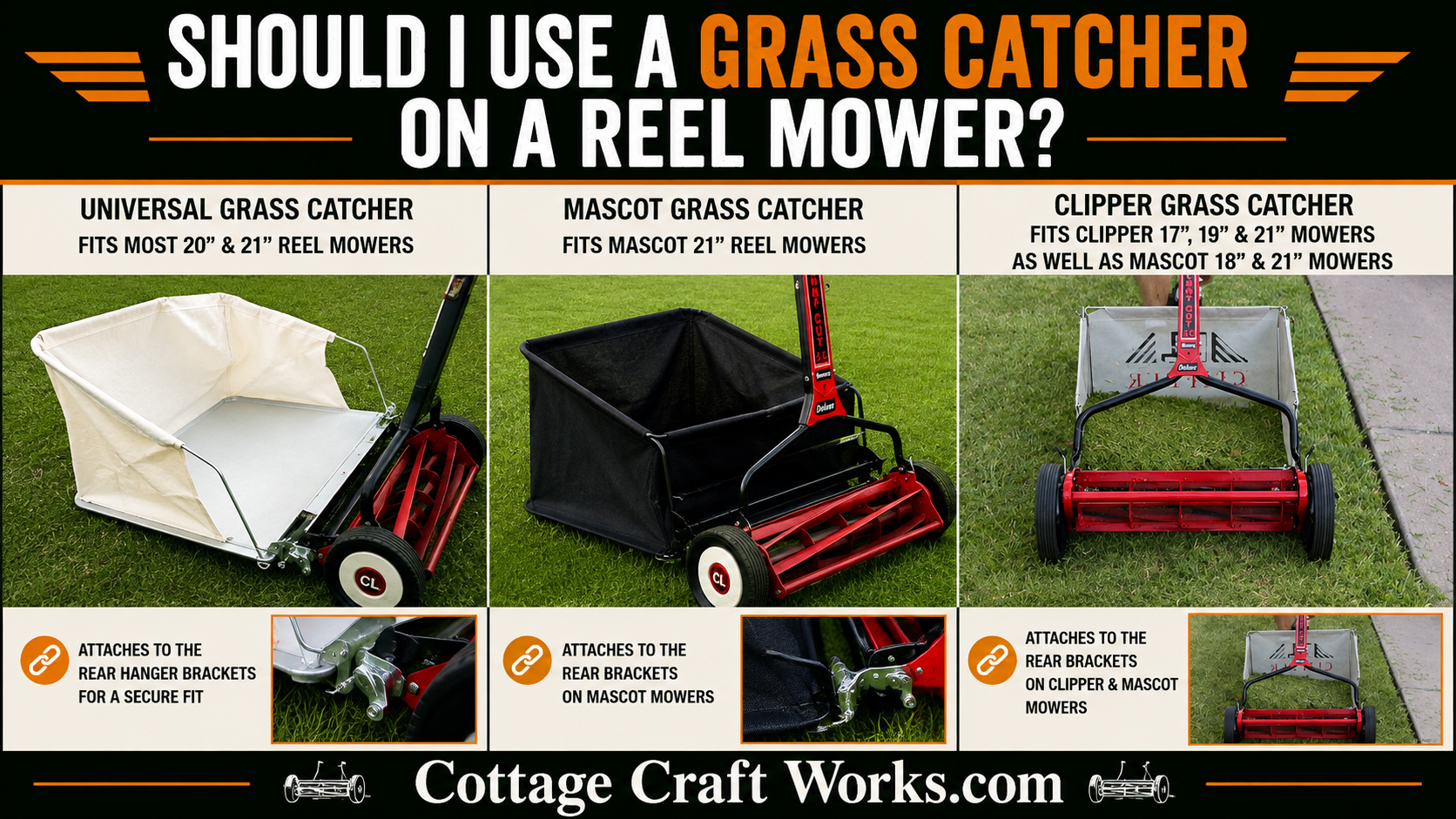
A grass catcher is not always necessary on a reel mower. When grass is mowed frequently and only a small amount is removed, the short clippings can normally be left on the lawn to decompose and return nutrients to the soil. A grass catcher becomes more useful when clippings are excessive, appearance is important, turf conditions favor collection, or you want to use the clippings for compost.
Just as important is choosing a catcher that fits the mower. Reel mower grass catchers use different mounting systems, and many so-called universal catchers will not attach properly to every reel mower.
Should I Use a Grass Catcher on a Reel Mower?
It depends on your lawn, how often you mow, how much grass you remove, and what you want to do with the clippings.
One advantage of a properly maintained reel mower is that it makes a clean, scissor-like cut rather than cutting the grass by impact. When mowing regularly, the resulting clippings are generally short enough that collecting them may be unnecessary.
Research from university turf programs supports leaving short clippings on healthy lawns. Grass clippings decompose quickly, return nutrients to the soil, and—contrary to a common misconception—are not a significant cause of thatch.
However, that doesn't mean a grass catcher is unnecessary for everyone.
The better question is:
Do the clippings benefit the lawn you are maintaining, or would you rather collect them?
Reel Mowing and Grasscycling
Reel mowers work best as finish mowers on regularly maintained turf, rather than as mowers for tall, overgrown grass.
For the Cottage Craft Works reel mowers covered in this resource guide, grass should generally be maintained within approximately ½" to 3", depending upon the grass species, mower, and desired finished height. This operating range should not be confused with a universal turf recommendation: some cool-season residential grasses are healthiest at approximately 3 inches or higher, at which point a reel mower may not be the best choice. Review the Cottage Craft Works Resource Guide “How to Choose a Push Reel Mower | Size, Grass & Cutting Height.”
The important principle is frequent mowing.
A widely accepted turf-management rule is to avoid removing more than approximately one-third of the grass blade in a single mowing.
When this is done, the clippings are relatively short and can usually settle between the standing grass blades rather than accumulating in clumps.
University of Minnesota Extension recommends that clippings approximately one inch or less can generally be left on the lawn because they filter down and decompose quickly. Longer accumulations should be removed if they could shade or smother the turf.
Leaving the Clippings on the Lawn
For many lawns, leaving short reel-mower clippings behind is the simplest option.
The practice is sometimes called grasscycling. The clippings contain nutrients that are returned to the soil as they decompose. Penn State reports that recycling turfgrass clippings can reduce fertilizer requirements, while the University of Minnesota notes that decomposed clippings can provide nutrients and improve soil quality.
Another misconception is that leaving clippings automatically causes thatch.
It generally does not.
Grass clippings consist primarily of easily decomposed leaf tissue. Thatch is primarily an accumulation of stems, roots, and other organic material that builds up faster than it decomposes.
So, if your reel mower is producing small clippings that disappear into healthy turf, there may be little reason to collect them.
When Should I Use a Grass Catcher?
There are situations where collecting the clippings makes more sense.
Consider using a grass catcher when:
- The mower is leaving visible clumps or windrows of clippings.
- The lawn has become taller than normal between mowings.
- You want a particularly clean, manicured appearance.
- Clippings are accumulating rather than filtering into the turf.
- Turf conditions make leaving excess material undesirable.
- You want to collect grass for composting.
- You don't want clippings tracked onto sidewalks, patios, pools, or into the house.
Collection may also be appropriate when certain turf diseases are present. University of Minnesota Extension specifically recommends removing clippings when lawns are heavily affected by diseases such as leaf spot, rust, or dollar spot to help reduce disease severity.
The goal isn't to declare catching or leaving clippings universally better. The right approach depends on the turf and mowing conditions.
Can I Compost Reel Mower Grass Clippings?
Yes.
Fresh grass clippings are considered a nitrogen-rich "green" compost material and can be combined with carbon-rich "brown" materials such as dry leaves, straw, or other dry plant material.
This can make a grass catcher particularly useful for gardeners who intentionally collect their clippings.
There is an important precaution, however.
Be careful with clippings from lawns recently treated with herbicides or other lawn chemicals. Recommendations vary by product, so follow the pesticide label before using treated clippings around vegetables, flowers, or shrubs, or in compost intended for those areas. Extension guidance specifically cautions against using certain herbicide-treated clippings as mulch around desirable plants.
What Type of Reel Mower Grass Catcher Do I Need?
This is where reel mower owners frequently run into trouble.
Don't select a grass catcher based only on mower width.
First, inspect the mower and determine how the catcher is supposed to attach.
A catcher can be the correct width and still be unusable if its mounting system doesn't match your mower.
Check the Roller Brackets First
Look at the mower's side plates and roller brackets.
Some reel mowers have hooks or mounting points specifically designed to support a grass catcher.
Many universal reel mower catchers use a lower attachment bar that rests on or hooks into mounting points extending from the mower's roller brackets. Mascot-style roller brackets are an example of this type of arrangement.
If your mower has the proper mounting points, installing and removing the catcher can be relatively simple.
If it doesn't, don't assume a universal catcher will fit.
The mower may require:
- grass-catcher-compatible roller brackets,
- an adapter,
- or a properly designed custom mounting arrangement.
Any modification should hold the catcher securely while still allowing it to be easily removed for emptying, without interfering with the reel, bedknife, wheels, roller, or other moving components.
Three Grass Catcher Designs to Consider
1. Universal Reel Mower Grass Catchers
Universal grass catchers are widely available online and are generally the least expensive option.
Before purchasing one, compare:
Width and capacity. A very small catcher may require frequent stops when mowing a larger lawn.
Bottom construction. Some inexpensive catchers have a flexible or poly bottom that can contact or drag across the turf.
Attachment system. Examine the lower mounting bar carefully and make sure it corresponds with the mounting points on your mower.
The word "universal" does not necessarily mean it will fit every reel mower.
2. Mascot Grass Catcher
The Mascot 21" grass catcher provides a reasonably sized collection area and is designed around the Mascot mower's attachment system.
For an owner who already has a compatible Mascot mower and wants a straightforward catcher, it can be a practical choice.
Capacity matters more than many buyers initially expected. A small catcher may cost less, but repeatedly stopping to empty it can be frustrating when mowing a larger lawn.
3. USA Clipper Grass Catcher
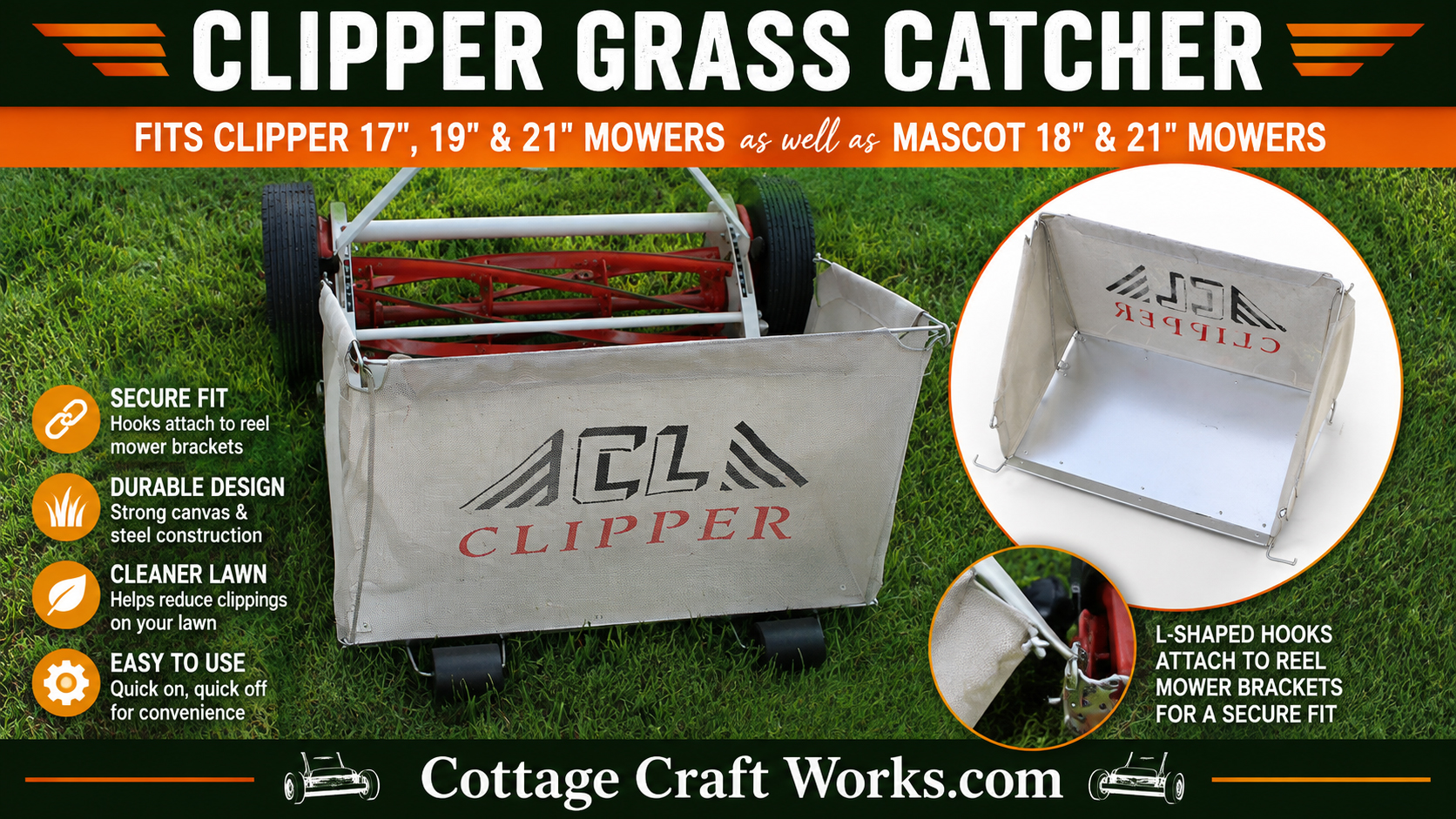
Cottage Craft Works recommends the USA Clipper Grass Catcher as the premium option for compatible Clipper and Mascot reel mowers.
The Clipper catcher uses spring attachment bars with L-shaped ends.
On compatible Mascot mowers, these ends can engage the catcher mounting points on the roller brackets. On compatible Clipper mowers, the L-shaped ends engage mounting holes in the mower side plates just above the rollers.
This mounting arrangement is important because many conventional universal catchers lack these spring-loaded L-shaped attachment bars and therefore may not attach properly to Clipper mower side plates.
Why Cottage Craft Works Recommends the Clipper Catcher
There are three primary advantages:
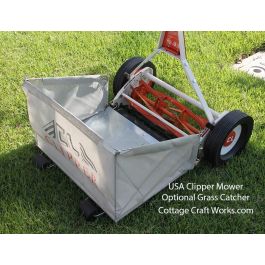
Metal bottom pan. Rather than relying on a flexible poly bottom dragging across the turf, the Clipper uses a metal collection pan.
Rear rollers. The catcher is supported by rollers as the mower travels across the lawn. This reduces the amount of catcher material dragging across the turf and the additional resistance that it can create.
Larger capacity. The larger catcher allows more grass to be collected before it needs emptying.
For someone who frequently catches clippings or maintains a larger area, these conveniences can be significant.
Is the Clipper Grass Catcher Worth the Extra Cost?
That depends upon how much you use it.
The USA Clipper Catcher can cost nearly three times as much as some basic universal grass catchers, so the premium construction will not make financial sense for everyone.
If you only occasionally collect clippings from a small lawn, an inexpensive compatible universal catcher may be perfectly adequate.
If you regularly collect clippings, maintain a larger lawn, want greater capacity, or want the metal pan and rear roller design, the additional cost of the Clipper catcher may be easier to justify.
Buy according to use, not simply according to which catcher is the most expensive.
Will the USA Clipper Grass Catcher Fit My Mower?
The Clipper catcher is particularly useful because its attachment design allows it to work with several compatible reel mower configurations.
For the Cottage Craft Works applications covered here, it can be used with compatible:
USA Clipper 17", 19", and 21" reel mowers and Mascot 18" and 21" reel mowers.
Because mower designs and brackets can change, visually confirm the mounting arrangement on your mower before ordering rather than relying solely on nominal cutting width.
How to Choose
For most owners, the decision can be simplified:
|
Your Situation |
Consider |
|
Short clippings disappear into healthy turf |
No catcher needed |
|
Want nutrients returned to lawn |
Leave clippings |
|
Want clippings for compost |
Use a catcher |
|
Lawn produces visible clumps |
Use catcher or mow more frequently |
|
Small lawn / occasional collection |
Compatible universal catcher |
|
Mascot 21" mower |
Mascot or compatible Clipper catcher |
|
Compatible Clipper mower |
Clipper catcher |
|
Frequent or larger-area collection |
Higher-capacity Clipper catcher |
|
Want metal pan and rear rollers |
Clipper catcher |
|
Mower has no catcher mounting points |
Correct brackets or adapter required |
Disclaimer
This information is provided for general educational and product-support purposes. Mower designs, adjustment procedures, hardware, and specifications may vary by model or production period. Always follow the manufacturer's current assembly, adjustment, maintenance, and safety instructions. Keep hands and fingers away from the reel and bedknife cutting surfaces, and use appropriate precautions whenever inspecting, adjusting, cleaning, or servicing a reel mower.
Key Takeaways
- A grass catcher is optional for many properly maintained reel-mowed lawns.
- Short clippings can normally be left on healthy turf and allowed to decompose.
- Grass clippings do not normally cause thatch.
- Follow the one-third mowing rule whenever practical.
- Collect excessive clippings rather than allowing heavy clumps to smother the turf.
- Collected grass can be a useful nitrogen-rich ingredient for compost.
- Don't assume a "universal" catcher will fit every reel mower.
- Inspect the mower's roller brackets, side plates, hooks, and mounting holes before purchasing.
- The Clipper catcher's spring bars and L-shaped ends provide compatibility with mounting arrangements that conventional universal catchers may not accommodate.
- Capacity, ease of emptying, rolling resistance, mounting method, frequency of use, and price should all factor into the purchase decision.
·
Photos
Clipper Grass Catcher 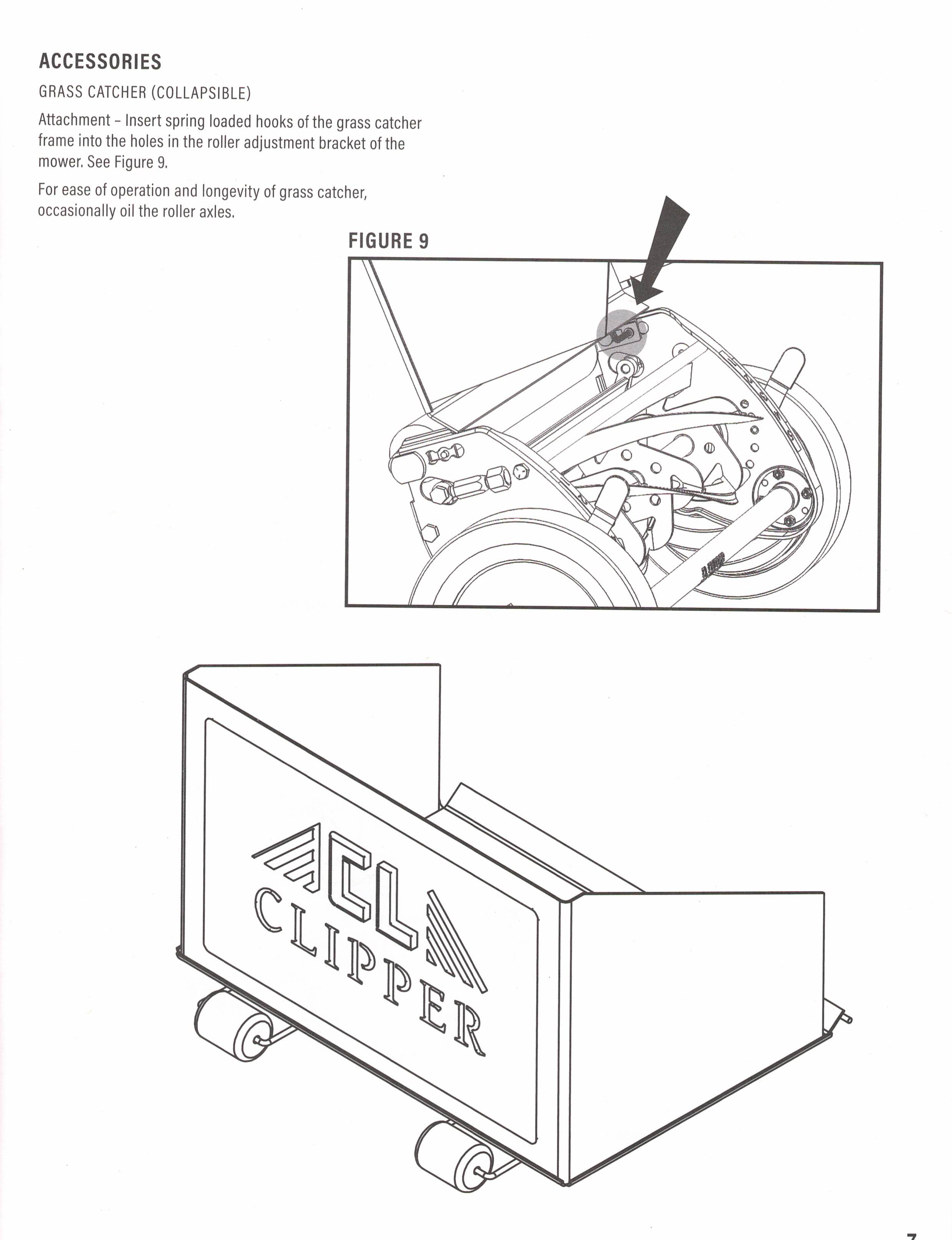
Clipper Grass Catcher Attachement Point 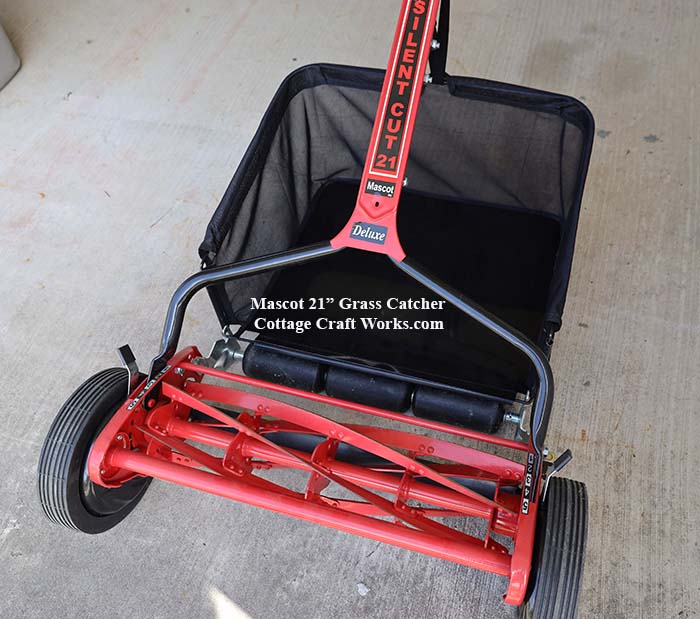
Mascot Grass Catcher 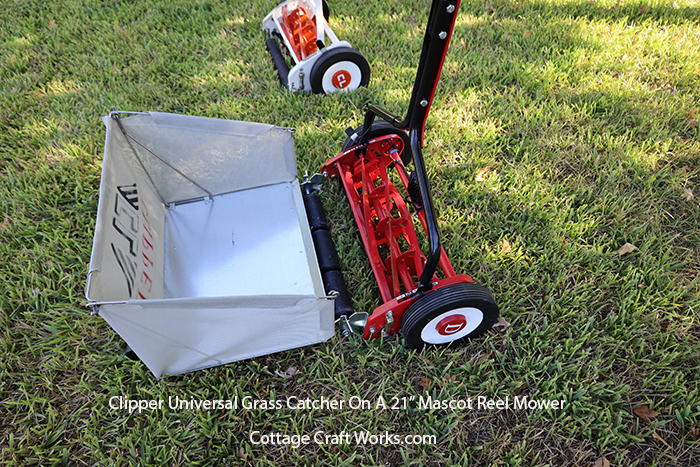
Clipper Grass Catcher on Mascot 21" Reel Mower
-rubber-wheels.jpg)