
Article
Meet the Heller-Aller 50L: How It Works, Deep-Well Planning & Installation Guide
How does the Heller-Aller 50L deep-well double-acting force pump work, and what is required to install it?
The Heller-Aller 50L uses two cylinders with different functions. A submerged lift cylinder, connected to the pump by sucker rod inside the drop pipe, raises water from below the pumping water level. A separate double-acting force cylinder near the wellhead routes and pressurizes the water so useful delivery occurs on both directions of the operating stroke. Before installation, verify casing clearance, total well depth, static and pumping water levels, well yield, discharge elevation and required pressure; then select the approved lift cylinder, pipe, rod, base and stroke. Because deep installations suspend long sections of pipe, rod and cylinder in the well, use controlled hoisting and positive pipe support or hire a qualified well contractor.
Meet the Heller-Aller 50L Deep-Well Double-Acting Force Pump
A heritage farm, ranch, homestead and windmill water pump designed for lifting and pressurized delivery

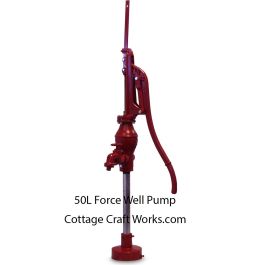
Heller-Aller 50L-style deep-well force-pump head and pipe assembly. Photograph supplied by Cottage Craft Works.
MEET THE 50L
The 50L is a heavy-duty, two-cylinder deep-well force-pump system. A submerged lift cylinder raises water from the well, while a separate double-acting force cylinder near the pump head helps deliver water under pressure on both strokes.
The Heller-Aller 50L is built for serious water service on farms, ranches, homesteads, remote properties, and off-grid systems. Unlike a simple shallow-well hand pump, the 50L combines a submerged lift cylinder with an upper double-acting force cylinder so water can be raised from depth and delivered beyond the wellhead to a pressure tank, elevated storage tank, stock tank, or other approved destination.
An American Water-Pump Design With Roots in 1886
Heller-Aller water-pump designs trace their American manufacturing heritage to 1886. Pumps of this general type helped supply homes, farms, ranches, livestock operations, and early industrial sites before electric pumping became common. Model 50L continues that practical mechanical tradition: durable cast construction, serviceable working parts and the ability to operate without utility power.
The 50L remains especially useful where a dependable manual or mechanically driven water source matters. It can still be found beneath windmills, at remote stock-watering sites and on off-grid properties. Amish communities and other users may operate it by hand, windmill or a correctly engineered mechanical pump-jack arrangement.
Why the 50L Is Different from a Basic Hand Pump
A shallow-well pitcher pump creates suction at the wellhead and is limited by atmospheric pressure. The 50L is a deep-well system: its working lift cylinder is placed below the water level, and the pump rod moves the cylinder plunger. This allows the system to raise water from depths that a suction pump cannot serve.
The other major difference is pressure delivery. The 50L uses a second, upper force cylinder in addition to the submerged lift cylinder. The upper cylinder is double acting, helping move water during both directions of the operating stroke and providing steadier delivery than a simple single-action arrangement.
|
Feature |
What it means for the owner |
|
Deep-well operation |
The lift cylinder works below the water level rather than relying on suction from the pump head. |
|
Two-cylinder system |
A submerged lift cylinder raises water; an upper double-acting force cylinder supports pressure delivery. |
|
Multiple power options |
The pump may be hand-operated or adapted to an approved windmill or a mechanical drive. |
|
Remote-water capability |
Water may be directed to a pressure system, an overhead tank, a stock tank, or another planned discharge. |
|
Serviceable construction |
Leathers, valves, rod components and other wear parts can be inspected and serviced. |
The Main Parts of a Complete 50L System
· Pump head and hand lever: convert hand or mechanical motion into reciprocating rod travel.
· Upper double-acting force cylinder receives raised water and helps provide a more continuous pressure discharge.
· Drop pipe carries water from the submerged cylinder to the pump head.
· Sucker rod: transfers motion from the pump mechanism to the submerged cylinder plunger.
· Submerged lift cylinder performs the primary deep-well lifting work and must remain adequately submerged.
· Well cap, mounting platform and discharge plumbing: support the assembly and route water to its destination.

USDA Forest Service illustration of a typical complete reciprocating hand-pump installation. Public-domain U.S. Government work; included for general system orientation, not as a Model 50L installation drawing.
Lift Cylinder Versus Force Cylinder
The two-cylinder names are often confused. The lift cylinder is the lower working cylinder installed in the well below the pumping water level. Its plunger and valves lift water into the drop pipe. The force cylinder is the upper cylinder associated with the 50L pump assembly. It helps force water into the discharge system and supports pumping on both strokes.

USDA Forest Service illustration of typical reciprocating pump cylinders, pistons, leathers and valves. Public-domain U.S. Government work; shown for operating context rather than as a Model 50L parts diagram.
How Double-Acting Pumping Benefits the System
In a single-acting pump, useful discharge is concentrated in one direction of the stroke. In a double-acting force cylinder, the piston alternately fills and discharges on opposite sides. The result is water movement on both strokes, a more even flow, and better suitability for filling tanks or supplying a properly designed pressure system.
Double-acting does not eliminate the need for correct cylinder sizing, stroke adjustment, check valves, pressure relief, and compatible plumbing. The well yield, pumping water level, total vertical lift, discharge elevation, desired pressure, and friction loss still determine whether the planned system is practical.
Current Model 50L Planning Specifications
Current Cottage Craft Works and manufacturer listings should be verified at the time of purchase because configurations and accessories may change.
|
Planning item |
Current listing information |
|
Recommended well casing |
Fits a 3-inch or larger casing; confirm actual inside clearance and all restrictions. |
|
Drop-pipe connection |
Commonly configured for 1-1/4-inch threaded pipe. |
|
Sucker rod |
The current listing identifies a 1/2-inch stainless-steel sucker rod. |
|
Stroke adjustment |
Adjustable 4-, 6-, and 9-inch stroke positions are listed. |
|
Base options |
Current listings identify mounting arrangements for common well-cap/platform sizes. |
|
Pressure capability |
The current seller information describes operation under pressure up to approximately 60 psi; verify the complete system rating. |
|
Deep-well capability |
Manufacturer information describes deep-well service to approximately 265 feet, subject to the actual installation and cylinder selection. |
Typical Uses
· Primary or backup water for rural homes and off-grid properties
· Windmill-operated livestock watering on ranches and remote pastures
· Filling an overhead gravity tank or a stock tank located away from the well
· Supplying a properly designed hydropneumatic or storage system
· Manual emergency water access when electrical power is unavailable
Hand, Windmill and Pump-Jack Operation
For occasional use, the hand lever provides direct manual operation. A windmill connection allows repeated pumping when wind conditions and the mechanism are suitable. Some installations use a gasoline engine or another mechanical pump jack, but speed, stroke, alignment, guarding, and over-travel protection must be engineered to prevent over-stroking or sideloading.
A mechanical drive should never be improvised from appearance alone. Use the correct connector and obtain the current guidance for stroke length, cycles per minute, and alignment from the pump or drive equipment manufacturer.
What Must Be Known Before Ordering
· Actual casing inside diameter and every restriction the cylinder must pass
· Total well depth, static water level, pumping water level and seasonal variation
· Tested well yield and the desired gallons per minute
· Vertical distance and pressure required at the final discharge point
· Cylinder bore, stroke and manufacturer-approved operating combination
· Drop-pipe material, sucker-rod size, couplings, corrosion conditions and sanitary requirements
· A safe plan for lifting, supporting and lowering the complete suspended assembly
A Deep Installation Is Not a Beginner Plumbing Project
At substantial depth, the installer handles long sections of pipe and sucker rod while the growing weight of the cylinder, pipe string, rod, and water column is suspended in the well. Each connection requires positive support and a controlled transfer of load. Losing a section can cause serious injury or cause the remaining assembly to drop into the well.

Concept illustration of a controlled deep-well installation using a qualified contractor and truck-mounted hoist. The six-inch casing and slender drop pipe are shown for scale; this is not a rigging diagram.
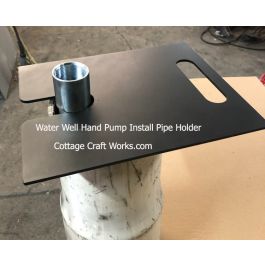
Cottage Craft Works carries a relatively inexpensive pump slide that fits around the drop pipe below a connector and rests on a suitable casing top while another pipe and rod section is connected. The slide is a useful support aid, but it is not a hoist, lifting clamp, fall-arrest device or substitute for a qualified crew and rated lifting equipment.
SAFETY DECISION
If the complete suspended assembly cannot be positively controlled during every connection, lowering step and load transfer, stop and hire a qualified well or pump contractor.
Where This Introductory Page Fits in the 50L Resource Series
This “Meet the 50L” page introduces the pump, its heritage, its two-cylinder operating concept, and the planning decisions that set it apart from a shallow-well hand pump. Separate Cottage Craft Works resources can then address how the 50L works in greater detail, well measurement and cylinder selection, installation planning, maintenance, rebuilding, and troubleshooting.
Sources and Illustration Credits
· Cottage Craft Works, “Heller Aller Windmill Double Acting Force Pump Model 50L,” current product and configuration information: https://cottagecraftworks.com/heller-aller-windmill-double-acting-force-pump-model-50l
· Hitzer Inc., “Model 50L Windmill Force Pump,” current manufacturer product information: https://hitzer.com/our-products/water-pumps/model-50l-windmill-force-pump
· USDA Forest Service, Engineering Field Notes, “Hand Pump Operation and Maintenance,” Vol. 13, Jan.-Feb. 1981. Public-domain U.S. Government work: https://www.fs.usda.gov/eng/pubs/pdfpubs/pdf81713801/pdf81713801.pdf
· USDA Forest Service, Operation and Maintenance Manual for Hand Pumps, 1999. Public-domain U.S. Government work: https://www.fs.usda.gov/t-d/pubs/pdf/99231209.pdf
Disclaimer
This resource is for general educational and planning purposes only. It is not a site-specific engineering design, installation manual, lifting plan, safety program, water-quality directive or substitute for current manufacturer instructions. Well conditions, loads, equipment, codes, licensing and sanitation requirements vary. Verify current specifications and component compatibility before purchase or installation. Deep-well work involves suspended loads, pinch points, long pipe and rod sections, heavy tools and the risk of dropping equipment into the well. Use properly rated lifting and support equipment and qualified personnel. The Cottage Craft Works pump slide is a pipe-support aid only; it is not a hoist, crane, lifting clamp, fall-arrest device or guarantee against slippage or equipment failure. Consult a licensed well or pump contractor and appropriate authorities whenever conditions, procedures or legal requirements are uncertain. Cottage Craft Works and CCW LLC assume no responsibility for injury, contamination, property damage, equipment loss, well damage or other consequences arising from use or misuse of this information or any product.