


Article
Horse-Drawn Vehicle Routine Maintenance & Lubrication Guide
How do you perform routine maintenance on a horse-drawn carriage, buggy or wagon?
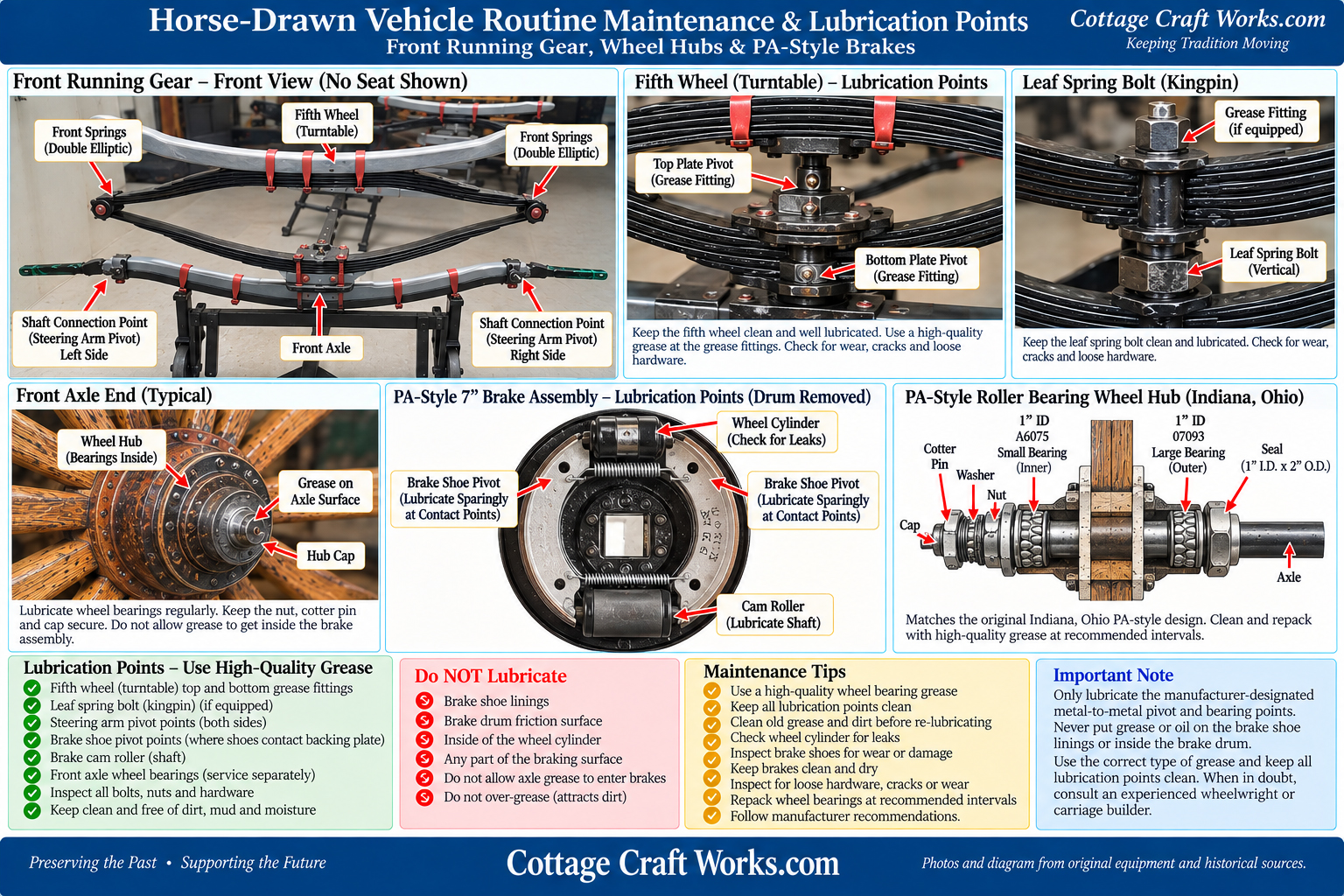
Routine horse-drawn vehicle maintenance includes a pre-use inspection, correct servicing of the particular axle or bearing system, lubrication and inspection of the fifth wheel and steering mechanism, checks of springs and fasteners, inspection of shafts or poles, and brake inspection where brakes are fitted.
Resource 1
Horse-drawn vehicles combine traditional construction with mechanical running gear that must carry the vehicle, occupants, and load while also steering, absorbing road shock, and controlling movement. Routine maintenance should therefore be systematic rather than limited to adding grease when a squeak develops.
University of Maine Cooperative Extension recommends inspecting wagons before the work season, making needed repairs, and checking lubrication of axle bearings and the steering system. That provides a useful baseline for a horse-drawn vehicle maintenance program.
1. Begin With a Pre-Use Walk-Around
· Look for a vehicle that is sitting lower on one corner, leaning, or showing an obvious change in wheel position.
· Check all wheels for wobble, loose or missing hardware, damaged tires, cracked wood, and unusual movement at the hub.
· Inspect shafts or the pole, singletree/doubletree attachments, body mounts, springs and visible fasteners.
· Check hydraulic brake tubing, hoses, and wheel areas for evidence of fluid leakage where brakes are fitted.
· Confirm that nothing is hanging below the vehicle where it can catch on the road or interfere with the horse.
2. Identify the Axle and Bearing System Before Servicing
Do not assume every buggy or carriage hub is serviced like a modern trailer hub. Traditional horse-drawn vehicles may use plain axle surfaces, older lubricated hub arrangements, or later roller-bearing hubs. The lubricant, adjustment method, and disassembly procedure must match the actual design.
|
System |
Maintenance Approach |
|
Traditional/plain axle or skein |
Inspect bearing surfaces for scoring or wear; clean and lubricate with the lubricant appropriate to the original design. |
|
Oil-lubricated hub design |
Check the manufacturer's or builder's instructions for oil type, level and sealing method. |
|
Serviceable roller-bearing hub |
Inspect bearings and races, clean as appropriate, repack with suitable wheel-bearing grease, inspect the seal and adjust bearing preload/end play correctly. |
|
Sealed bearing assembly |
Do not attempt to pack a sealed bearing unless its manufacturer specifically provides a service procedure. |
3. Wheel Bearing and Hub Inspection
1. Park on firm, level ground and prevent the vehicle from moving.
2. Before lifting, observe wheel alignment and check for obvious looseness.
3. Use a suitable jack only at a structurally appropriate lifting point and support the vehicle with properly rated stands or blocking before working on or beneath it.
4. With the wheel safely raised, rotate it by hand. Listen and feel for roughness, grinding, binding, or irregular resistance.
5. Check for excessive side-to-side or top-to-bottom movement at the wheel and hub.
6. If the hub is serviceable, inspect the bearings, races, seals, and spindle or axle surfaces during scheduled service.
7. Replace damaged components rather than attempting to compensate for damage by overtightening an adjustment.
4. Packing Serviceable Roller Bearings
When the vehicle uses serviceable roller bearings, remove old, contaminated grease and inspect the bearing rollers and races for pitting, discoloration, scoring, corrosion, or other damage. Work fresh, compatible wheel-bearing grease through the bearing until it distributes throughout the roller cage. Install a serviceable seal and adjust the hub according to the bearing or hub manufacturer's procedure.
Alpha Weather Guard EP 2 Grease is exclusively used by the Weaver Town Coach Shop in Bird-n-Hand, PA, for all their carriage and buggy repairs.
Unlike regular wheel bearing grease, which is designed for high-speed and high-heat applications, Alpha Weather Guard EP 2 Grease is formulated for the unique demands of horse-drawn carriages, buggies, and wagons. It minimizes resistance at lower speeds, ensuring optimal operation without requiring high-temperature tolerances.
Do not mix incompatible greases or use a general-purpose lubricant merely because it is available. Brake contamination is also a concern: keep grease away from brake shoes, drums and friction surfaces.
5. Fifth Wheel, Turntable and Kingpin
On a four-wheel carriage or wagon, the fifth wheel or turntable allows the front running gear to rotate beneath the body. Dirt, dried lubricant, and corrosion increase friction and wear. Clean accessible plate surfaces before adding the lubricant appropriate to the design.
· Inspect the fifth-wheel plates or turntable for cracks, distortion, and abnormal wear.
· Keep the contact surfaces adequately lubricated without allowing grease to become a heavy abrasive mixture of dirt and road grit.
· Inspect the kingpin and its retaining hardware for looseness, damage and wear.
· Check steering stops, reach hardware and related pivots where fitted.
· After lubrication, turn the front gear through its normal range and verify smooth movement without binding.
6. Springs, Suspension and Running Gear
· Inspect leaf springs for broken leaves, shifted leaves, severe corrosion, and damaged center bolts or clips.
· Check spring shackles, hangers, U-bolts and attachment hardware for looseness or elongation of holes.
· Look for cracks or deterioration in wooden reaches, bolsters and other structural running-gear components.
· Investigate new squeaks, knocks, side movement or changes in ride height rather than simply masking them with lubricant.
7. Shafts, Pole and Hitching Hardware
Inspect shafts and poles along their full length, paying special attention to bends, cracks, splits, repaired areas, bolt holes and attachment points. Check singletrees, doubletrees, neck-yoke hardware, holdback attachment points and other draft hardware for wear or looseness.
8. Brake System Check
Where hydraulic brakes are fitted, inspect the master cylinder, tubing, flexible connections, wheel cylinders, brake shoes and adjustment. Investigate brake fluid loss, a changing pedal feel, pulling, dragging, or reduced braking performance before further use. Brakes assist the horse and should never be treated as a substitute for a properly trained horse, correctly fitted harness and sound driving practices. See Cottage Craft Works Taperlock Horse-Drawn Vehicle Carriage & Buggy Brake Resource Guide for more troubleshooting guides.
9. Suggested Maintenance Schedule
|
Interval |
Recommended Check |
|
Before each use |
Walk-around, wheels/tires, shafts or pole, hitching hardware, brakes, obvious loose fasteners and leaks. |
|
Monthly during regular use |
Hub play, steering/fifth wheel, springs, body mounts, brake linkage/tubing and lubrication points. |
|
Seasonally |
Thorough running-gear inspection; clean and lubricate service points; inspect bearings/axles according to design. |
|
Annually or by manufacturer interval |
Service applicable wheel bearings/hubs; inspect fifth wheel/kingpin, brakes, suspension and structural attachments. |
|
After long storage or a road impact |
Complete inspection before returning the vehicle to service. |
Important Safety & Maintenance Disclaimer
This Cottage Craft Works resource is provided for general educational and informational purposes only. Horse-drawn carriages, buggies, wagons and carts vary substantially in age, construction, materials, wheel and axle design, steering systems, brakes, suspension, intended loads and operating conditions. A maintenance, inspection or repair procedure appropriate for one vehicle may not be appropriate for another.
Wheels, axles, bearings, hubs, fifth wheels, kingpins, steering components, brakes, springs, shafts, poles, wooden structural members and attachment hardware are safety-critical components. Failure or improper adjustment of these components can result in loss of vehicle control, property damage, serious injury or death.
Always inspect the vehicle before use and follow the vehicle or component manufacturer's instructions when available. Properly support a raised vehicle before working underneath it or removing wheels. Do not rely solely on a jack or other lifting device to support a vehicle while performing maintenance.
Do not operate a horse-drawn vehicle when a wheel, axle, bearing, steering component, brake, shaft, pole, structural wooden member or other safety-critical component is damaged, excessively worn, loose, deteriorated or of questionable condition.
Repairs involving structural wooden wheels, hubs, spokes, felloes, shafts, poles, major body structures or specialized running gear should be performed or evaluated by an experienced wheelwright, carriage builder or other qualified craftsperson when the condition or proper repair procedure is uncertain.
Lubrication & Lifting Warning
Do not assume all horse-drawn vehicle axles, hubs or bearings use the same lubricant or service procedure. Traditional plain-bearing axles, oil-lubricated systems and modern roller-bearing hubs may require different procedures and lubricants. Identify the axle and bearing design before servicing it. When wheels must be raised or removed, properly block the vehicle and support it with equipment capable of safely carrying the vehicle's weight.
Cottage Craft Works LLC assumes no responsibility or liability for injury, property damage, equipment damage or other loss resulting from the inspection, maintenance, repair, modification, installation or operation of horse-drawn vehicles or their components.
Reference Sources
The following public or institutional references were used as background for this educational resource. Vehicle-specific manufacturer instructions should take precedence when available.
· University of Maine Cooperative Extension — Wagon Safety, Bulletin #2337. Recommends pre-season inspection and checking lubrication of axle bearings and the steering system.
· Clemson University — Wagon Wheel conservation project. Documents traditional wood-and-iron wheel construction and the interaction of wood, iron and changing moisture conditions.
