
Article
Types of Tinctures & Botanical Extracts: Choosing the Right Press Basket & Mesh Bag
Why do different tinctures, herbs, and fruits require different press baskets and pressing bags?
Different botanical materials behave differently under hydraulic pressure. Coarse fibrous herbs work well with a standard tincture basket and the standard 60-mesh pressing bag, while soft fruit, pulp, and finely macerated material can push the flexible bag through larger basket perforations. Cottage Craft Works offers a smaller-perforation soft-fruit basket to provide greater bag support and an optional Fine 160 Mesh Bag with 93-micron openings for greater retention of small particles.
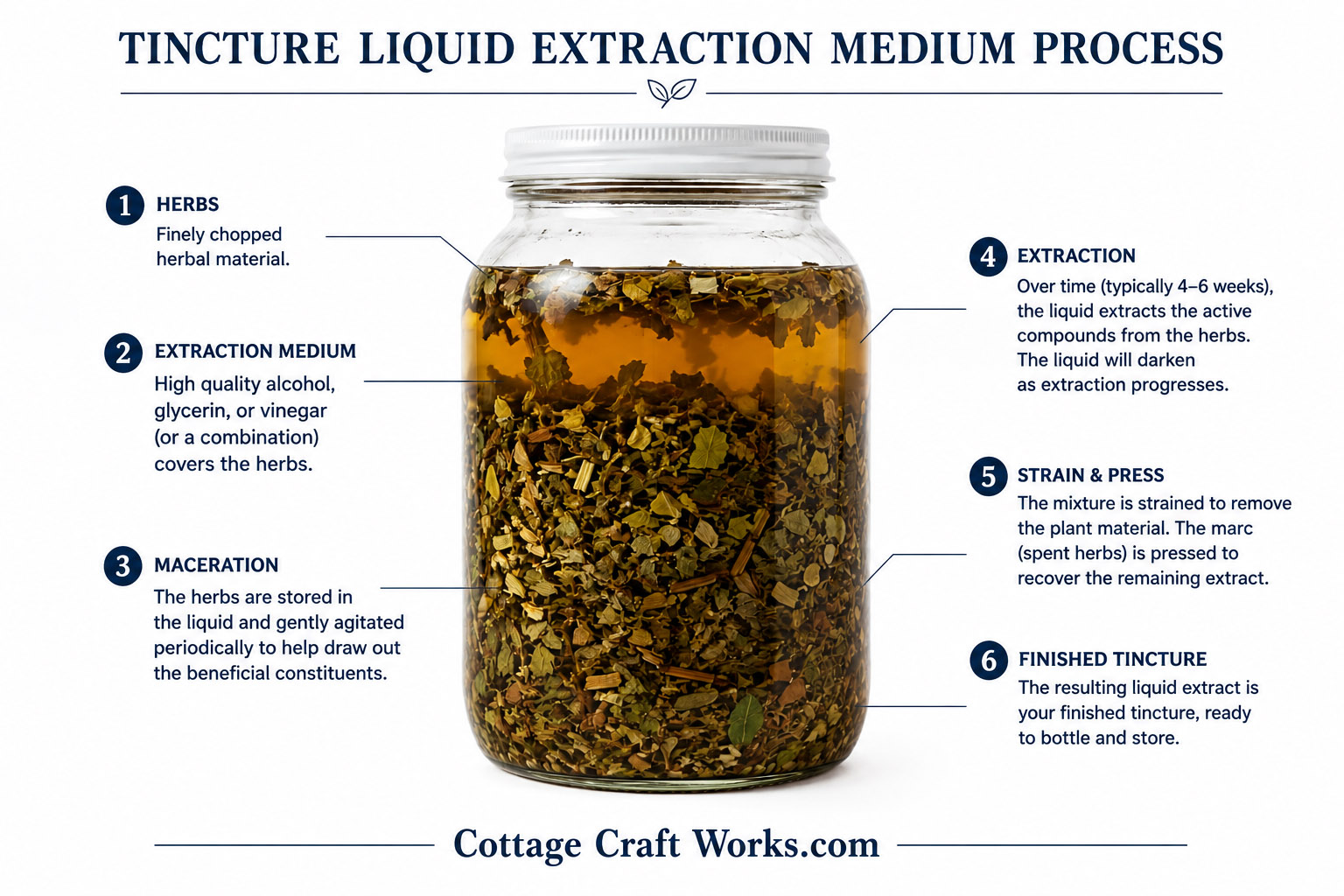
Not every botanical extract is the same—and not every extracted material behaves the same when it is pressed.
Traditional alcohol tinctures, glycerites, vinegar extracts, culinary flavor extracts and fruit-based preparations can contain everything from coarse fibrous roots to extremely soft fruit pulp. Cottage Craft Works offers two press-basket designs and two pressing-bag mesh options so the equipment can be better matched to the material being processed.
Understanding these differences can improve drainage, solids retention, pressing-bag support, unloading, and overall processing efficiency.
Tinctures Aren't All the Same
The term tincture is commonly associated with medicinal herbal preparations, but botanical extraction encompasses a much wider range of products.
Plants, herbs, roots, fruits, berries, spices, peels, and other botanicals can be extracted for medicinal, culinary, flavoring, and other applications.
Just as importantly, not every liquid botanical preparation is technically a tincture.
The extraction medium—often called the menstruum—and the intended use help determine what type of preparation is being produced.
Alcohol Tinctures
Traditional herbal tinctures generally use a combination of ethanol and water as the extraction medium.
Alcohol and water have different solvent properties, allowing the combination to extract a broad range of botanical constituents.
The botanical material may include:
- Leaves
- Flowers
- Stems
- Roots
- Bark
- Seeds
- Berries
- Other suitable plant parts
After maceration, the liquid is drained, and the saturated botanical material—the marc—can be pressed to recover any liquid remaining within it.
Glycerites
A glycerite is a botanical preparation that uses vegetable glycerin as an important component of the extraction medium.
Glycerites are often selected when alcohol is undesirable, but they should not simply be regarded as alcohol tinctures with glycerin substituted for ethanol.
Glycerin has different solvent and physical characteristics. It is also considerably more viscous than an alcohol-and-water menstruum.
The botanical, particle size, glycerin concentration, and formulation can therefore influence both extraction and pressing behavior.
Vinegar Extracts
Vinegar can also serve as an acidic botanical extraction medium for appropriate applications.
These preparations are more accurately described as vinegar extracts rather than traditional tinctures.
Again, the important principle is that changing the extraction liquid changes the extraction process. Alcohol, glycerin, and vinegar are not automatically interchangeable.
Infused Oils
An infused botanical oil uses a carrier oil rather than the alcohol-and-water menstruum associated with a traditional tincture.
These preparations are distinct from tinctures and are commonly associated with salves, balms, skin preparations, and other oil-based products.
Oil extraction presents its own processing considerations, as viscosity and botanical material characteristics can affect liquid separation.
Culinary & Flavor Extracts
Botanical extraction isn't limited to medicinal preparations.
Appropriate food-grade botanicals can be extracted specifically for flavor and aroma.
Examples can include:
- Vanilla
- Culinary herbs
- Spices
- Citrus peel
- Berries
- Soft fruits
- Aromatic botanicals
For these applications, culinary extract, flavor extract or botanical flavoring is often more appropriate terminology than medicinal tincture.
Soft-Fruit & Berry Extracts
Soft fruits deserve particular attention because they behave very differently from coarse herbs under hydraulic pressure.
Berries and other soft fruits can break down during maceration into a wet, highly compressible pulp.
Examples include:
- Strawberries
- Raspberries
- Blackberries
- Blueberries
- Cherries
- Peaches
- Other suitable soft fruits
After gravity draining, this pulp can retain a considerable amount of flavored liquid.
A hydraulic press can recover additional liquid, but the physical characteristics of soft fruit introduce an equipment issue that may not occur to someone accustomed to pressing coarse herbs.
That is the reason Cottage Craft Works offers two different basket designs.
Why Cottage Craft Works Offers Two Press Basket Options
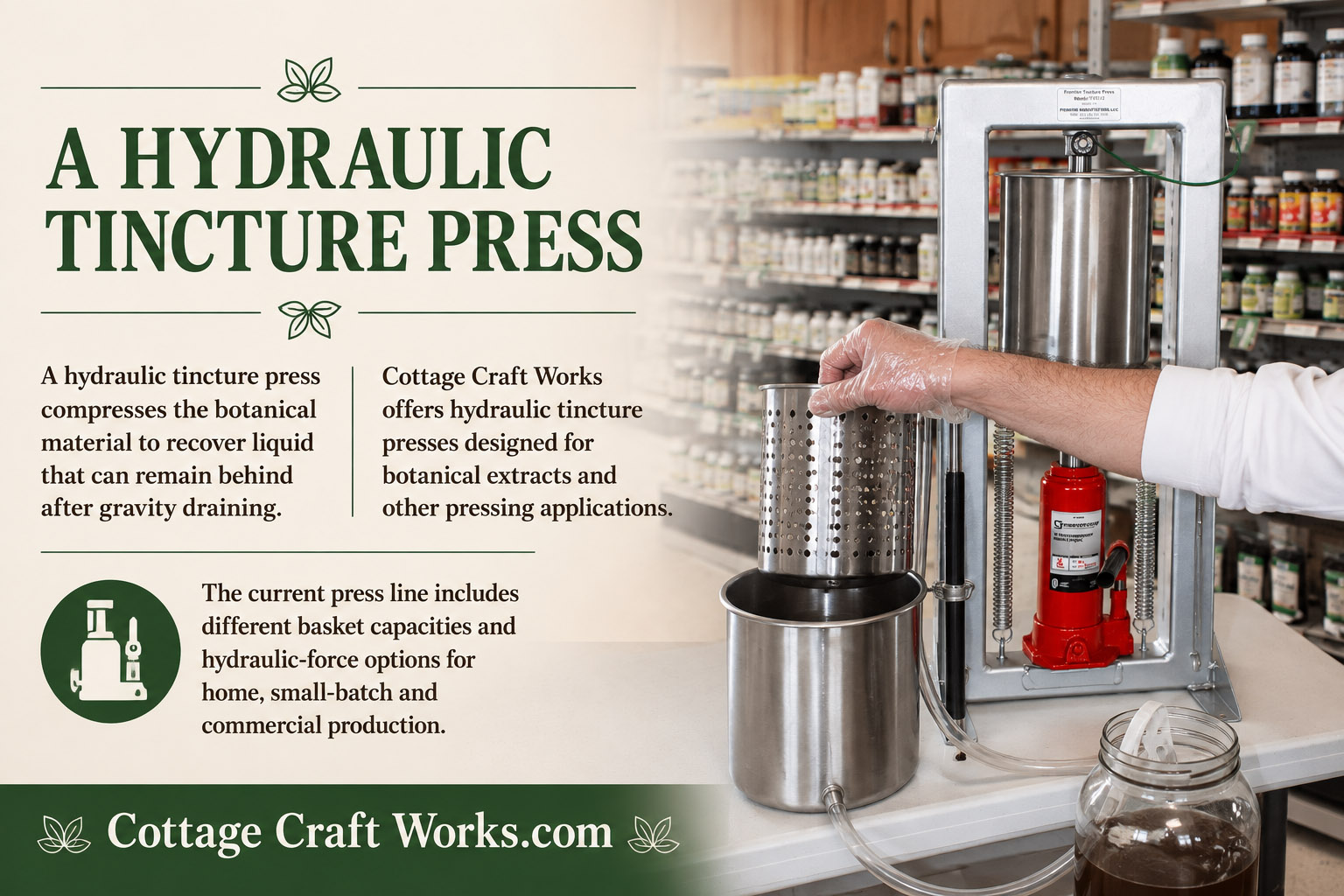
A hydraulic tincture press does much more than squeeze material between two plates.
As pressure is applied, the pressing bag and its contents are forced outward against the perforated stainless-steel basket.
How the material behaves at that point depends greatly upon its consistency.
Standard Tincture Basket
The standard tincture basket is designed primarily for conventional herbal and botanical pressing.
Coarse leaves, stems, roots and other fibrous plant material generally retain more of their physical structure during pressing.
The basket's larger perforations provide ample drainage area, allowing liquid to escape through the pressing bag and into the collection vessel.
The standard basket is therefore well suited to materials such as:
- Coarsely cut herbs
- Roots
- Stems
- Fibrous botanicals
- Conventional tincture marc
- Other relatively coarse botanical material
Why Soft Fruit Creates a Different Problem
Soft fruit, finely processed herbs, and heavily macerated botanical material can behave almost like a paste when compressed.
As hydraulic pressure increases, this soft mass pushes the flexible pressing bag firmly against the basket wall.
With the larger openings found in a conventional tincture basket, portions of the flexible pressing bag can begin to push outward through the perforations.
This can create small protrusions or “tentacles” of bag material around the soft pulp.
The problem may not become apparent until pressing is finished.
When the operator attempts to pull the bag from the basket, these protrusions can remain caught in the basket holes. Pulling upward on the bag can then stretch, snag or tear the pressing bag.
This is why simply putting a different filter bag into the same basket doesn't necessarily solve every soft-material pressing problem.
Cottage Craft Works Soft-Fruit Basket
Cottage Craft Works addresses this problem by offering a dedicated soft-fruit/fine-material basket with smaller perforations.
The smaller holes provide more support for the pressing bag while still allowing the recovered liquid to flow through the basket.
This reduces the opportunity for large sections of flexible bag material to be pushed through the holes in individual baskets under hydraulic pressure.
The soft-fruit basket can be particularly useful for:
- Soft fruits
- Berries
- Fruit pulp
- Finely chopped botanicals
- Soft flowers and leaves
- Heavily macerated material
- Other materials that become paste-like when compressed
The distinction is important:
The standard basket emphasizes drainage for conventional fibrous botanical material. The soft-fruit basket provides additional support for pressing bags of highly compressible material.
Why Cottage Craft Works Offers Two Pressing-Bag Mesh Options
The basket supports the pressing bag, which contains the botanical material and controls how much solid material can pass into the recovered liquid.
Cottage Craft Works offers two polyester mesh options.
Standard 60-Mesh Pressing Bag
Standard 60-mesh bags are shipped with Cottage Craft Works tincture presses.
Specifications
- White polyester
- 60 threads per inch
- 120-micron thread diameter
- 210-micron mesh thickness
- 303-micron mesh opening
The standard 60-mesh bag provides a practical balance between liquid flow and solids retention.
Its relatively open 303-micron openings allow extracted liquid to escape readily while retaining the bulk of conventional botanical material.
This makes it a good general-purpose choice for:
- Coarse herbs
- Stems
- Roots
- Leaves
- Fibrous botanicals
- General tincture marc
Fine 160-Mesh Pressing Bag
For material producing much smaller particles, Cottage Craft Works also offers an optional Fine 160-Mesh Pressing Bag.
Specifications
- White polyester
- 160 threads per inch
- 63-micron thread diameter
- 105-micron mesh thickness
- 93-micron mesh opening
The much smaller 93-micron openings provide greater retention of fine botanical and fruit particles during pressing.
The Fine 160 Mesh Bag can be particularly useful for:
- Soft fruit
- Berries
- Fruit pulp
- Finely chopped herbs
- Fine botanical material
- Preparations producing greater amounts of suspended solids
Understanding Mesh Count vs. Micron Opening
The mesh number can initially seem backward.
A 60-mesh bag has a 303-micron opening, while the 160-mesh bag has a much smaller 93-micron opening.
That's because mesh count refers to the number of threads per inch rather than the size of the opening itself.
In simple terms:
60 Mesh = 303-micron opening = more open
160 Mesh = 93-micron opening = finer
The 160-mesh bag therefore retains smaller particles, while the 60-mesh bag generally permits freer liquid flow.
Pressing Bag Sizes
Cottage Craft Works pressing bags are sized for the corresponding tincture press baskets.
|
Press Size |
Approximate Pressing Bag Size |
|
1-Gallon Press |
13" W × 16" H |
|
2-Gallon Press |
16" W × 18" H |
|
3-Gallon Press |
22" W × 20" H |
Matching the Basket and Pressing Bag to the Material
This is where the two basket choices and two bag choices work together.
|
Material |
Recommended Basket |
Bag Starting Point |
|
Coarse herbal tincture marc |
Standard Tincture |
60 Mesh |
|
Roots & fibrous botanicals |
Standard Tincture |
60 Mesh |
|
Leaves & stems |
Standard Tincture |
60 Mesh |
|
Finely chopped herbs |
Depends on consistency |
160 Mesh |
|
Soft fruit |
Soft-Fruit |
160 Mesh |
|
Berries |
Soft-Fruit |
160 Mesh |
|
Fine fruit pulp |
Soft-Fruit |
160 Mesh |
|
Soft/paste-like botanical marc |
Soft-Fruit |
160 Mesh |
|
Material needing greater solids retention |
Basket matched to consistency |
160 Mesh |
These are starting recommendations rather than absolute rules. Particle size, moisture content, extraction medium, and the extent to which the material breaks down during maceration can all affect pressing characteristics.
Basket Perforations and Bag Mesh Solve Different Problems
This distinction is particularly important.
Basket perforation size primarily affects physical support and drainage.
Pressing-bag mesh primarily affects containment and particle retention.
Using a finer bag doesn't necessarily eliminate the need for a soft-fruit basket.
If soft material pushes the bag itself through large basket openings, the issue isn't merely filtration—it is physical support of the bag under hydraulic pressure.
Likewise, installing a soft-fruit basket doesn't automatically provide finer filtration. The pressing bag still determines much of the solids retention during pressing.
The two components should therefore be considered as a system.
Why This Matters With an 8- or 20-Ton Hydraulic Press
A hydraulic tincture press can generate substantial force.
That pressure is transferred through:
Hydraulic Jack → Plunger → Botanical Material → Pressing Bag → Basket
As pressure increases, the botanical mass becomes progressively more compact.
Coarse fibrous herbs and soft berry pulp do not react to that force in the same manner.
The objective should not simply be to apply the maximum available tonnage. The objective is to recover liquid efficiently while using a basket and pressing bag appropriate for the material being processed.
Pressure should be applied progressively, allowing recovered liquid time to drain.
Pressing Bags Are Not Final Filtration
Even the Fine 160 Mesh Bag has an opening of approximately 93 microns.
That means very fine particles can remain suspended in the recovered extract.
This does not indicate that the pressing bag failed. The pressing bag and final filter perform different functions.
The pressing bag contains the bulk botanical material during hydraulic pressing.
After pressing, the extract may be allowed to settle so fine particles migrate toward the bottom of the container. The clearer liquid can then be carefully decanted and filtered further if required.
A complete workflow may therefore look like:
Macerate → Gravity Drain → Select Basket & Bag → Hydraulic Press → Settle → Decant → Fine Filter → Bottle
More Than Medicinal Tinctures
Offering different baskets and pressing bags also expands the range of items a Cottage Craft Works press can process.
A customer isn't necessarily purchasing a machine solely for medicinal herbal tinctures.
Depending upon the appropriate formulation and application, the same basic hydraulic liquid-separation principle can be useful for:
Herbal tinctures → botanical extracts → glycerites → culinary extracts → fruit extracts → berry preparations → flavor extracts → infused preparations → juice and other compatible pressing applications.
This is an important reason Cottage Craft Works offers both basket styles.
One press can serve many different applications, but the material-contact components should be selected based on what is actually being pressed.
Disclaimer
This information is provided for educational purposes only and is not medical, legal, or regulatory advice. Regulations and requirements may change and vary by product, location, and intended use. Commercial producers are responsible for determining and complying with all current federal, state, and local requirements applicable to their products and operations.
Useful links
- Open link
Cottage Craft Works Hydaulic Tincture Press Options