
Article
Types of Herbal Tinctures & Botanical Extracts
What are the different types of herbal tinctures and botanical extracts?
Traditional herbal tinctures generally extract botanical material using alcohol and water. Other botanical preparations include glycerites made with vegetable glycerin, vinegar extracts using an acidic menstruum, infused oils using carrier oils, and water-based infusions or decoctions. These methods are not interchangeable because different extraction media dissolve different types of botanical constituents. The appropriate method depends upon the specific plant, plant part, whether the material is fresh or dried, the desired constituents, and the intended finished preparation.
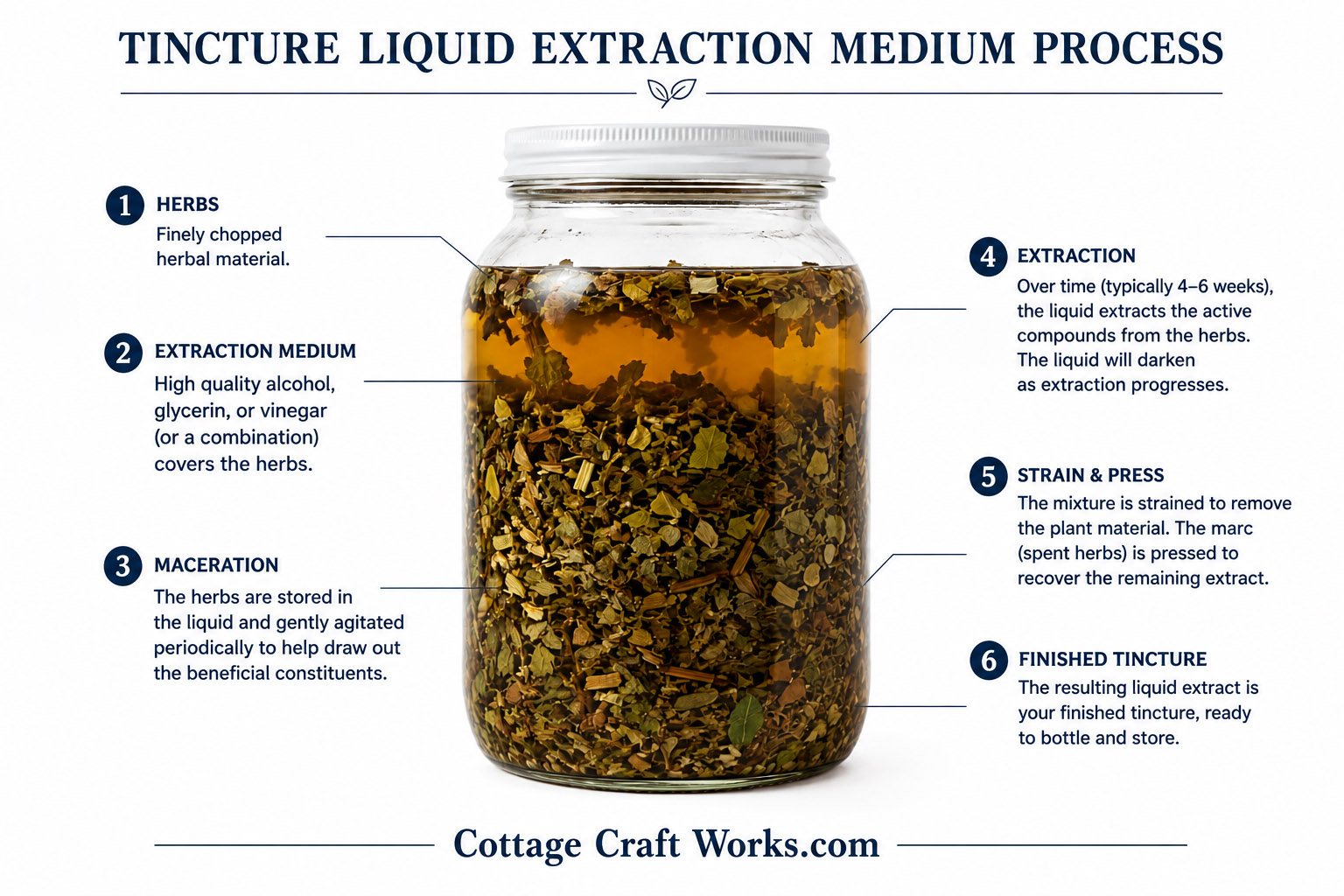
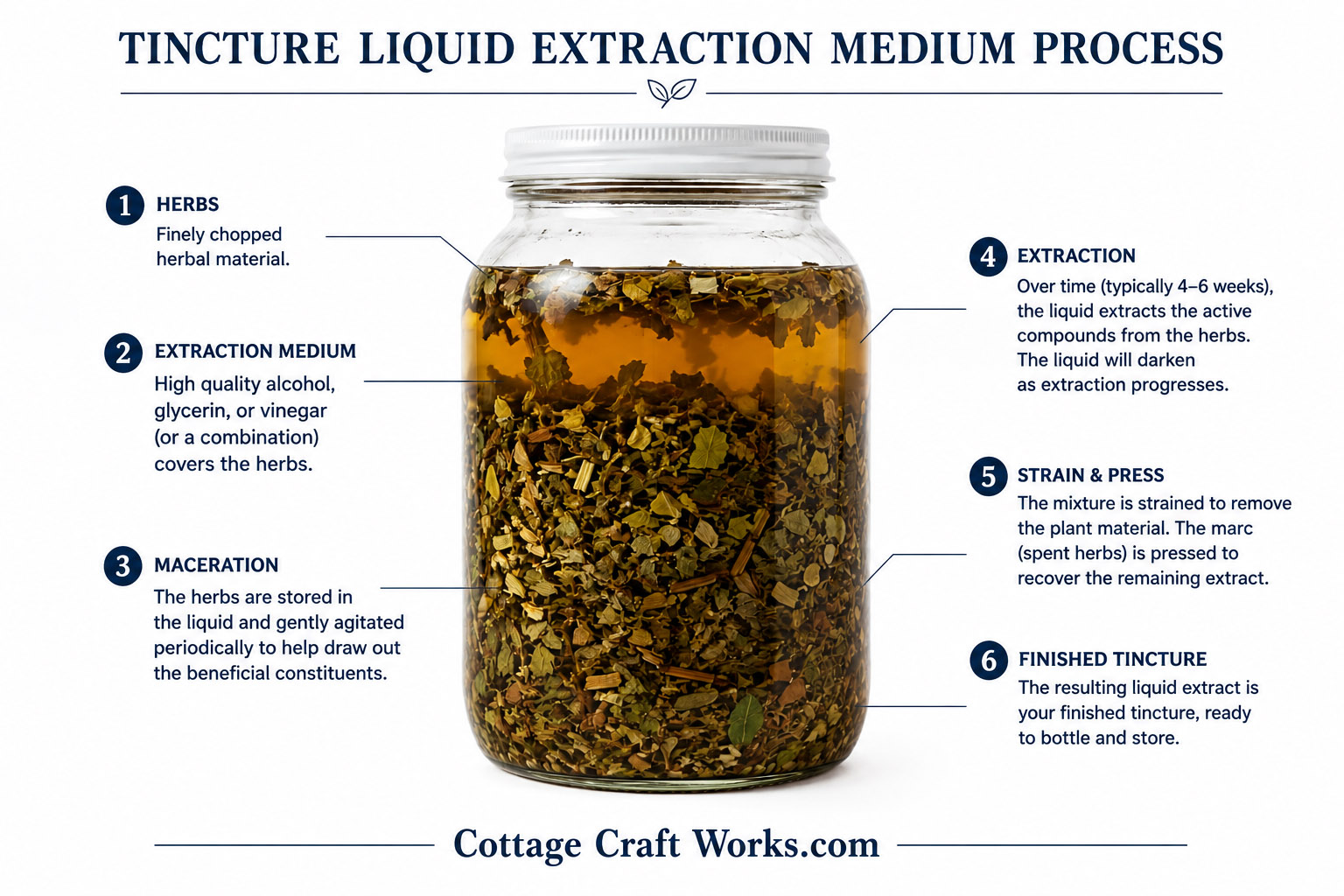
Herbal extracts are made by placing botanical material in a liquid or other extraction medium that draws selected constituents from the plant material. However, not all herbal extracts are tinctures, and extraction liquids are not interchangeable.
Traditional tinctures generally use alcohol and water. Alcohol-free botanical preparations may instead use vegetable glycerin or vinegar, while infused oils use a completely different oil-based extraction process.
The best extraction method depends on the botanical, plant part, desired constituents, intended use, and finished preparation.
Understanding these differences becomes especially important when moving from casual home preparation to repeatable small-batch or commercial production.
What Are the Different Types of Herbal Tinctures and Extracts?
The word tincture is frequently used online as a general description for almost any concentrated liquid herbal preparation. Technically, however, different extraction media produce different types of botanical extracts.
The extraction liquid is commonly called the menstruum. The botanical material being extracted is sometimes called the marc, particularly after it has soaked and is ready to be strained and pressed.
Choosing a menstruum is more than deciding whether the finished preparation contains alcohol. Plants contain many different compounds, and those constituents do not all have identical solubility characteristics.
For that reason, a method that works well for one botanical or plant part may not be appropriate for another.
Alcohol Tinctures
An alcohol tincture is the preparation most accurately associated with the traditional meaning of the word tincture.
Botanical material is macerated in an ethanol-based menstruum, typically containing both ethanol and water.
Why are alcohol and water combined?
Alcohol and water have different solvent properties. Using them together can broaden the range of botanical constituents extracted compared with relying entirely upon either one.
The appropriate alcohol-to-water concentration varies according to the botanical and the constituents being targeted. There is therefore no single alcohol percentage that should automatically be applied to every herb.
Advantages of alcohol tinctures
Alcohol-based tinctures are popular because they can:
- extract a broad range of botanical constituents;
- work with many different leaves, flowers, roots, bark, berries and other plant materials;
- produce concentrated liquid preparations;
- generally have good storage stability when properly prepared and stored;
- be easily filtered and bottled;
- work well with repeatable weight-to-volume production ratios.
Considerations
Alcohol is not appropriate or desirable for every user or every preparation. Its flammability also introduces storage and workplace considerations as production volume increases.
The correct alcohol concentration should be determined from reliable information about the particular botanical rather than from a universal Internet tincture recipe.
Glycerites
A glycerite is a botanical extract that uses vegetable glycerin as an important part of the extraction medium instead of relying upon alcohol as the primary solvent.
Glycerin has a naturally sweet taste, which can make glycerites appealing when the taste or presence of alcohol is undesirable.
Although people sometimes call these products “alcohol-free tinctures,” glycerite is the more useful descriptive term because the extraction chemistry and finished preparation differ from a traditional alcohol tincture.
Advantages of glycerites
Glycerites may be considered when:
- an alcohol-free preparation is desired;
- a sweeter finished extract is preferred;
- the botanical's desired constituents are compatible with glycerin extraction;
- the finished product is being formulated around glycerin's characteristics.
Are glycerites made exactly like alcohol tinctures?
No.
Simply replacing alcohol with glycerin in an existing tincture formula does not necessarily produce an equivalent extract.
Glycerin has different viscosity, solvent properties, preservation characteristics, and handling requirements. The botanical, water content, glycerin concentration and intended storage should all be considered.
This distinction is important for anyone developing repeatable products.
Vinegar Herbal Extracts
Vinegar provides another traditional method of extracting botanical material.
These preparations generally use an acidic vinegar—commonly a food-grade vinegar—as the extraction medium.
Vinegar has different solvent characteristics from alcohol and glycerin and therefore should not be treated as a direct substitute for either.
Why use vinegar?
Its acidic environment can be useful for certain types of extraction, particularly where acid-soluble constituents are of interest.
Vinegar preparations also offer an alcohol-free option.
However, they typically differ from alcohol tinctures in taste, extraction characteristics and storage properties.
Is a vinegar extract a tincture?
In everyday conversation it may occasionally be described that way, but vinegar extract is more precise.
Calling every concentrated herbal liquid a tincture can make it difficult for consumers to understand how the product was actually produced.
Infused Herbal Oils
An infused herbal oil is fundamentally different from an alcohol tincture, glycerite or vinegar extract.
Plant material is placed in a carrier oil so that oil-soluble constituents can migrate into the oil.
Common carrier oils can include olive oil and other suitable vegetable oils, depending upon the intended preparation.
What are infused oils generally used for?
Herbal oils are commonly associated with preparations intended for external use or as ingredients in products such as:
- salves;
- balms;
- ointments;
- massage oils;
- skin preparations;
- soaps and related handcrafted products.
The specific botanical and finished use determine whether a particular preparation is appropriate.
Why aren't infused oils tinctures?
The primary solvent is oil rather than an alcohol-and-water menstruum.
That changes what can be extracted, how the preparation is processed, its storage characteristics and how the finished extract is used.
Alcohol Tincture vs Glycerite vs Vinegar Extract vs Infused Oil
|
Preparation |
Primary Extraction Medium |
General Characteristic |
|
Alcohol Tincture |
Ethanol + water |
Traditional tincture with broad extraction capabilities |
|
Glycerite |
Vegetable glycerin, often with water |
Sweeter botanical extract and alternative when alcohol is undesirable |
|
Vinegar Extract |
Food-grade vinegar |
Acidic, alcohol-free botanical extraction |
|
Infused Herbal Oil |
Carrier oil |
Extracts oil-soluble constituents into an oil base |
The important lesson is:
These aren't four interchangeable liquids for the same recipe.
Changing the menstruum changes the extraction process.
Water-Based Herbal Preparations
Water should also be addressed because people researching “types of herbal extracts” will encounter infusions and decoctions.
An herbal infusion generally uses hot or cold water to extract botanical constituents. Herbal teas are familiar examples.
A decoction generally involves simmering tougher plant materials, such as certain roots or bark, in water.
These preparations demonstrate another important principle: different plant parts and desired constituents may require different extraction techniques.
They are generally not classified as tinctures.
Fresh Herbs vs Dried Herbs
The condition of the botanical also affects extraction.
Fresh plants contain substantial natural moisture. When fresh botanical material is added to a menstruum, that plant moisture becomes part of the extraction system and can change the final solvent concentration.
Dried botanicals contain much less moisture and can absorb substantial quantities of the menstruum.
This is one reason a recipe developed for dried material should not automatically be converted to fresh herbs—or vice versa—without adjusting the formulation.
The plant species, plant part, moisture content, extraction ratio and menstruum concentration should all be considered together.
Single-Herb Extracts vs Herbal Formulas
Another important distinction is between a single-herb extract and a multi-herb formula.
Single-Herb Extract
A single-herb extract uses one botanical, although a particular plant may still involve a specifically selected part such as its:
- leaf;
- flower;
- root;
- bark;
- seed;
- berry;
- or other identified botanical material.
Single-herb extraction can simplify production documentation because the producer can establish a specific formula for that botanical.
For example, records can identify:
Botanical → plant part → fresh/dried condition → weight → menstruum → ratio → alcohol concentration when applicable → extraction period → pressing date → finished yield.
That becomes particularly valuable for commercial production.
Multi-Herb Formulas
A formula combines two or more botanical ingredients into a finished preparation.
There are two basic production approaches.
Method 1 — Extract the Herbs Together
Compatible botanical ingredients can sometimes be combined and extracted as one formulation.
This simplifies the number of batches but can complicate extraction when the individual plants would perform better with different ratios or extraction media.
Method 2 — Extract Separately and Blend Later
Each botanical can instead be extracted according to its own formulation and the finished extracts blended afterward.
For production operations, this approach has significant advantages.
It allows the producer to document and control each botanical independently.
If one herb requires a different extraction ratio or solvent concentration, it does not force the entire formula to use the same extraction conditions.
It can also make finished-product consistency easier to manage from batch to batch.
Why Extraction Medium Matters
The extraction medium should be selected based upon what needs to be extracted from the plant, rather than simply which liquid is most convenient.
Plant material contains different classes of compounds with differing chemical properties. Some are more soluble in water, some respond better to alcohol-containing systems, and others are better suited to oil or different extraction conditions.
This is why Cottage Craft Works should avoid presenting a single “master tincture recipe.”
A more accurate approach is:
Identify the botanical first. Determine the desired preparation second. Then select the extraction medium, concentration and ratio appropriate for that particular material.
That provides much stronger educational content.
What Happens After Extraction?
Regardless of the extraction medium, there eventually comes a point when the liquid must be separated from the botanical material.
The first step may simply involve draining or straining.
However, saturated botanical material can retain a substantial amount of liquid.
This spent, saturated plant material is commonly referred to as the marc.
Hand squeezing may be adequate for very small batches. As batches become larger, more frequent, or more valuable, mechanically pressing the marc becomes increasingly practical.
A hydraulic tincture press compresses the botanical material to recover liquid that remains after gravity drainage.
Disclaimer
This information is provided for educational purposes only and is not medical, legal, or regulatory advice. Regulations and requirements may change and vary by product, location, and intended use. Commercial producers are responsible for determining and complying with all current federal, state, and local requirements applicable to their products and operations.
Frequently Asked Questions
Is a glycerite a tincture?
A traditional tincture generally relies upon ethanol and water. Glycerin has different solvent, viscosity and preservation characteristics. Therefore, an alcohol-tincture recipe should not automatically be converted into a glycerite simply by replacing the alcohol with glycerin.
The extraction method should be tailored to the specific botanical and the glycerin-based menstruum.
Why is alcohol used to make tinctures?
The water portion and alcohol portion have different solvent properties, which is why traditional tincture formulas commonly use a combination rather than pure alcohol.
The appropriate concentration depends upon the botanical and desired constituents. There is no single alcohol percentage that is ideal for every herb.
Alcohol can also contribute to the storage stability of properly prepared tinctures, which is one reason alcohol extraction became a traditional method for preserving botanical preparations.
Can vinegar be used to extract herbs?
However, vinegar does not extract plants in exactly the same way as an alcohol-and-water menstruum does. It has different solvent properties, taste and storage characteristics.
For that reason, vinegar should be selected because it is appropriate for the particular botanical preparation—not merely substituted cup-for-cup for alcohol in a tincture recipe.
Are infused herbal oils tinctures?
Traditional tinctures generally use alcohol and water as the extraction medium, whereas infused oils use a carrier oil.
Oil preferentially extracts oil-soluble botanical constituents, producing a fundamentally different finished preparation. Infused oils are commonly incorporated into salves, balms, ointments, massage oils, and other topical preparations.
What is a menstruum?
Depending upon the preparation, the menstruum might contain alcohol and water, vegetable glycerin, vinegar, water, oil or another appropriate extraction medium.
Choosing the correct menstruum is one of the most important decisions in botanical extraction.
What is marc?
Once the liquid has been drained, the wet plant material may still contain considerable extract. Pressing the marc mechanically can recover liquid that gravity draining or ordinary hand squeezing may leave behind.
This is where a hydraulic tincture press becomes particularly useful for larger or repeated batches.
Is alcohol or glycerin better for making herbal extracts?
Alcohol-and-water tinctures and glycerites have different extraction characteristics. The better choice depends upon the botanical, desired constituents, intended finished product, storage requirements and whether alcohol is acceptable in the preparation.
The extraction medium should be chosen for the botanical rather than choosing a botanical to fit a preferred solvent.
Can I substitute glycerin for alcohol in a tincture recipe?
Replacing alcohol with glycerin changes the solvent system and can change what is extracted, the viscosity of the preparation, processing requirements and storage characteristics.
A glycerite should be treated as its own formulation, rather than as an alcohol tincture with one ingredient swapped.
Are fresh or dried herbs better for botanical extraction?
Fresh botanicals contain considerably more natural moisture, while dried herbs contain less water and may absorb more of the extraction liquid. Consequently, fresh and dried preparations may require different ratios and menstruum concentrations.
The best choice depends upon the particular botanical and extraction method.
What is the difference between a single-herb extract and an herbal formula?
For small commercial producers, extracting plants individually can offer an important advantage: each botanical can have its own documented ratio, solvent concentration, extraction time and batch record.
The finished single-herb extracts can then be measured and blended into a multi-herb formula.
Should multiple herbs be extracted together or separately?
When several botanicals are placed into the same extraction vessel, they generally share the same menstruum and extraction conditions. That may not be ideal when the individual plants have substantially different extraction requirements.
Extracting them separately allows each botanical to be processed according to its own formula before the finished extracts are blended.
This can be particularly valuable for repeatable small-batch and commercial production.
Do all herbal extracts need to be pressed?
Very small batches may be adequately strained and hand-squeezed. However, saturated botanical material can retain extract after gravity draining.
As batch size, ingredient cost, and production frequency increase, hydraulic pressing becomes more useful because it provides considerably greater mechanical pressure while reducing repetitive hand squeezing.
Can the same hydraulic tincture press handle different types of botanical extracts?
The important distinction is that the press performs the physical liquid-separation step—it does not determine the chemistry of the extraction.
That is a particularly useful concept to emphasize throughout the Cottage Craft Works resource library because it connects alcohol tinctures, glycerites and other compatible botanical extraction processes to the press without implying that they all use the same formulation.
A properly designed food-processing press can mechanically separate liquid from many types of saturated botanical material, but the suitability depends upon the material, viscosity, filtering arrangement and equipment specifications.
The important distinction is that the press performs the physical liquid-separation step—it does not determine the chemistry of the extraction.
That is a particularly useful concept to emphasize throughout the Cottage Craft Works resource library because it connects alcohol tinctures, glycerites and other compatible botanical extraction processes to the press without implying that they all use the same formulation.
Not necessarily.
Very small batches may be adequately strained and hand-squeezed. However, saturated botanical material can retain extract after gravity draining.
As batch size, ingredient cost, and production frequency increase, hydraulic pressing becomes more useful because it provides considerably greater mechanical pressure while reducing repetitive hand squeezing.
Can the same hydraulic tincture press handle different types of botanical extracts?
A properly designed food-processing press can mechanically separate liquid from many types of saturated botanical material, but the suitability depends upon the material, viscosity, filtering arrangement and equipment specifications.
The important distinction is that the press performs the physical liquid-separation step—it does not determine the chemistry of the extraction.
That is a particularly useful concept to emphasize throughout the Cottage Craft Works resource library because it connects alcohol tinctures, glycerites and other compatible botanical extraction processes to the press without implying that they all use the same formulation.