
Article
How to Start a Small Herbal Tincture & Botanical Extract Business
What do I need to start a tincture business?
A tincture business needs documented ingredient sourcing, repeatable formulations, appropriate extraction and pressing equipment, sanitation procedures, batch records, packaging, true product costing, inventory controls, applicable regulatory compliance, and a marketing plan based on truthful product information.

Turning a personal tincture-making activity into a business involves much more than making larger batches.
A producer needs a repeatable system for ingredient sourcing, formulation, extraction, pressing, filtration, bottling, recordkeeping, inventory, costing, labeling, quality control, and marketing.
Sourcing Herbs, Botanicals, Fruits & Berries
One of the most important considerations when starting a tincture business is the cost and availability of raw botanical materials. A producer purchasing dried herbs, roots, berries, fruits, or other botanicals at retail or wholesale prices must include those acquisition costs when calculating the actual cost of each tincture bottle.
Existing growers and processors may have a significant advantage.
Farms, herb growers, orchards, berry producers, juice processors, and dried-herb businesses may already have access to substantial quantities of suitable botanical material. Processing may also produce secondary botanical material that would otherwise have limited commercial value, such as stems removed during dried-herb production or suitable fruit and berry material remaining from other processing operations.
When the particular plant and plant part are appropriate for extraction, these materials may potentially be macerated in a suitable solvent and pressed to produce an additional value-added product.
For example:
Grow → Harvest → Primary Product → Recover Suitable Botanical Material → Macerate → Press → Filter → Bottle → New Product & Revenue Stream
A dried-herb producer might sell the desirable leaves or flowers as the primary product while evaluating suitable stems and other separated plant material for extraction. Likewise, a fruit or berry operation may be able to evaluate suitable secondary material from its processing operation rather than treating all of it as waste.
Turning an Existing Crop Into Another Revenue Stream
This can substantially change the economics of starting a tincture operation. A business already growing or processing botanicals has made much of the investment required to obtain the original plant material. Tincture production can potentially create an additional revenue stream from the same harvest.
Rather than viewing tincture production only as a stand-alone business, growers should ask:
- What crops or botanicals are we already growing or purchasing?
- What plant material is currently discarded or underutilized?
- Which of those plant parts are appropriate and safe for extraction?
- Can material currently used for dried herbs, juices, or other products support an additional tincture product line?
- What additional revenue could be generated from each harvest after accounting for solvent, labor, equipment, filtration, testing, bottles, labels, sanitation, and regulatory compliance?
Important Commercial Consideration
Not every stem, fruit residue, berry byproduct, or other botanical material should automatically be made into a tincture. Plant identity, plant part, condition, intended use, extraction method, safety, and applicable regulatory requirements must all be considered.
Commercial producers should also maintain appropriate lot identification and traceability. Material intended for extraction should be handled as a potential product ingredient from the beginning—not collected later from material that has been improperly stored, contaminated, or treated as ordinary waste.
1. Define What You're Producing
Determine:
- what botanicals will be processed;
- whether products are single-herb extracts or formulas;
- intended extraction media;
- package sizes;
- expected batch quantities;
- intended sales channels.
Do this before purchasing equipment.
2. Research Regulatory Classification
A product's intended use, ingredients, labeling, and marketing can affect how it is regulated.
Do not assume that every bottled herbal liquid falls into the same regulatory category.
Be sure to study the compliance requirements resource, Cleaning, Sanitation & Facility Requirements for Tincture Production, so that you don't end up on the wrong side with federal, state, and local enforcement agencies.
3. Establish Ingredient Sourcing
Commercial production requires more than finding the lowest-cost dried herb.
Track:
- botanical identity;
- supplier;
- plant part;
- lot;
- origin when relevant;
- specifications;
- receiving date;
- supplier documentation.
4. Develop Repeatable Formulations
Document the process sufficiently that the next batch can be produced in the same way.
5. Establish Batch Records
Every batch should tell its own production story.
Record ingredients, quantities, lots, dates, equipment and major processing stages.
6. Determine Equipment
A small operation may need:
- weighing equipment;
- extraction vessels;
- measuring equipment;
- strainers;
- pressing bags;
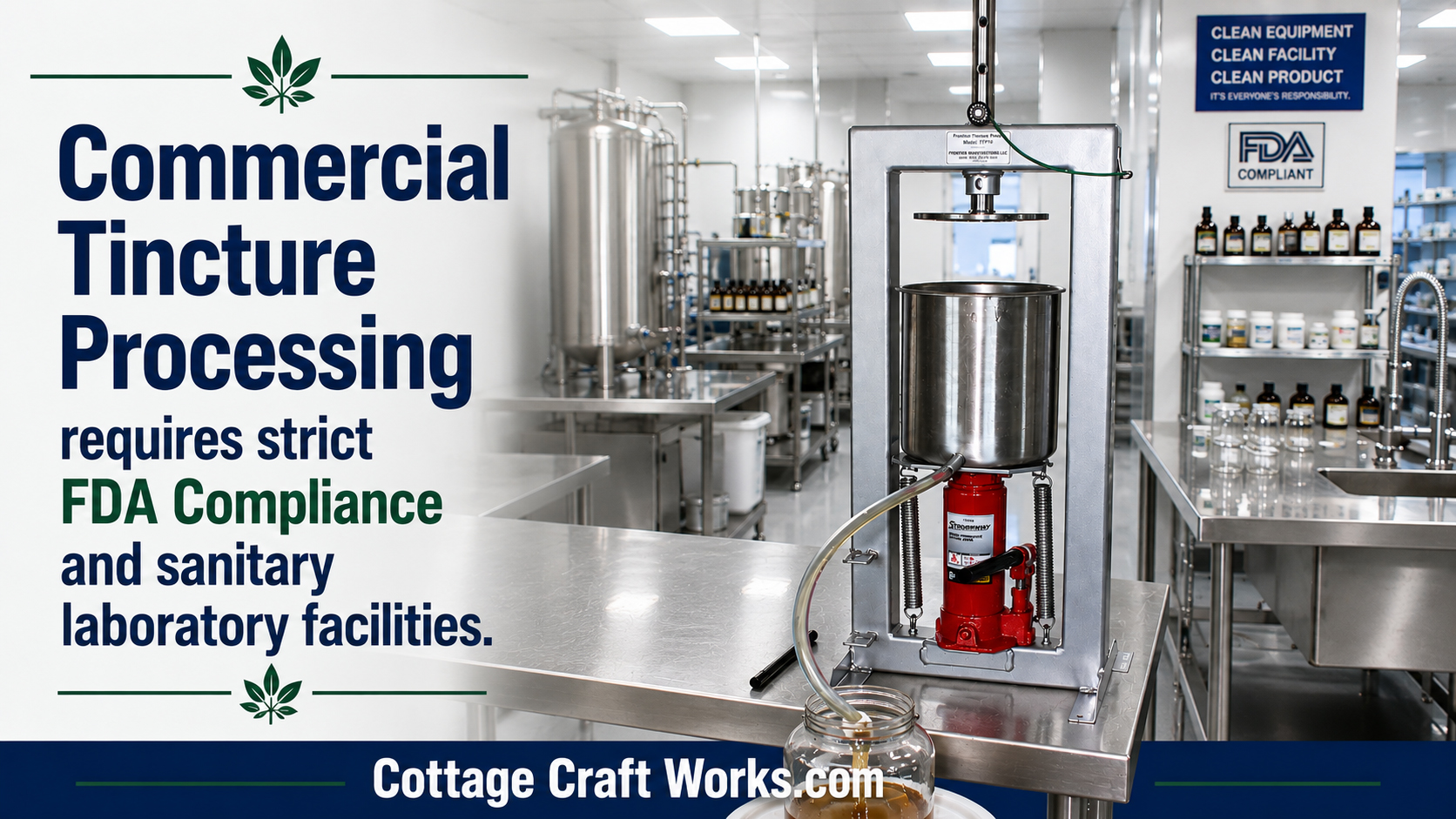
- hydraulic tincture press;
- collection vessels;
- filtration equipment;
- bottling/filling equipment;
- storage equipment;
- cleaning and sanitation equipment.
7. Calculate True Production Cost
The working formula established in the resource plan is:
Raw botanicals + extraction medium + bottles/closures + labels + labor + equipment allocation + testing + packaging + overhead + selling costs = true batch cost.
Then:
True batch cost ÷ saleable bottles = actual production cost per bottle.
Don't confuse ingredient cost with product cost.
8. Account for Labor
Track actual production time.
Include:
- receiving;
- weighing;
- preparation;
- extraction setup;
- pressing;
- filtering;
- bottling;
- labeling;
- cleanup;
- documentation.
9. Establish Pricing
Your selling price has to cover more than just production costs.
It may also need to support:
- merchant fees;
- advertising;
- website expenses;
- wholesale margins;
- damaged product;
- shipping materials;
- returns;
- insurance;
- regulatory/compliance expenses;
- business profit.
10. Develop a Marketing Position
Competing solely on claims of health benefits creates both regulatory risk and weak differentiation.
Instead, businesses can communicate factual characteristics such as:
- botanical identity;
- sourcing;
- extraction method;
- ratio;
- production process;
- traceability;
- craftsmanship;
- packaging;
- testing, when applicable.
-
Disclaimer
This information is provided for educational purposes only and is not medical, legal, or regulatory advice. Regulations and requirements may change and vary by product, location, and intended use. Commercial producers are responsible for determining and complying with all current federal, state, and local requirements applicable to their products and operations.
Useful links
- Open link
Cottage Craft Works Hydraulic Tincture Presses