
Article
How & Why to Press Tincture Marc
Why should tincture marc be pressed?
Tincture marc can retain liquid after gravity draining because the saturated botanical mass holds the extraction medium between and within the plant material. Hand squeezing can recover some of this liquid in small batches, while a hydraulic tincture press applies greater, more controlled mechanical pressure to separate the retained extract from larger quantities of marc.

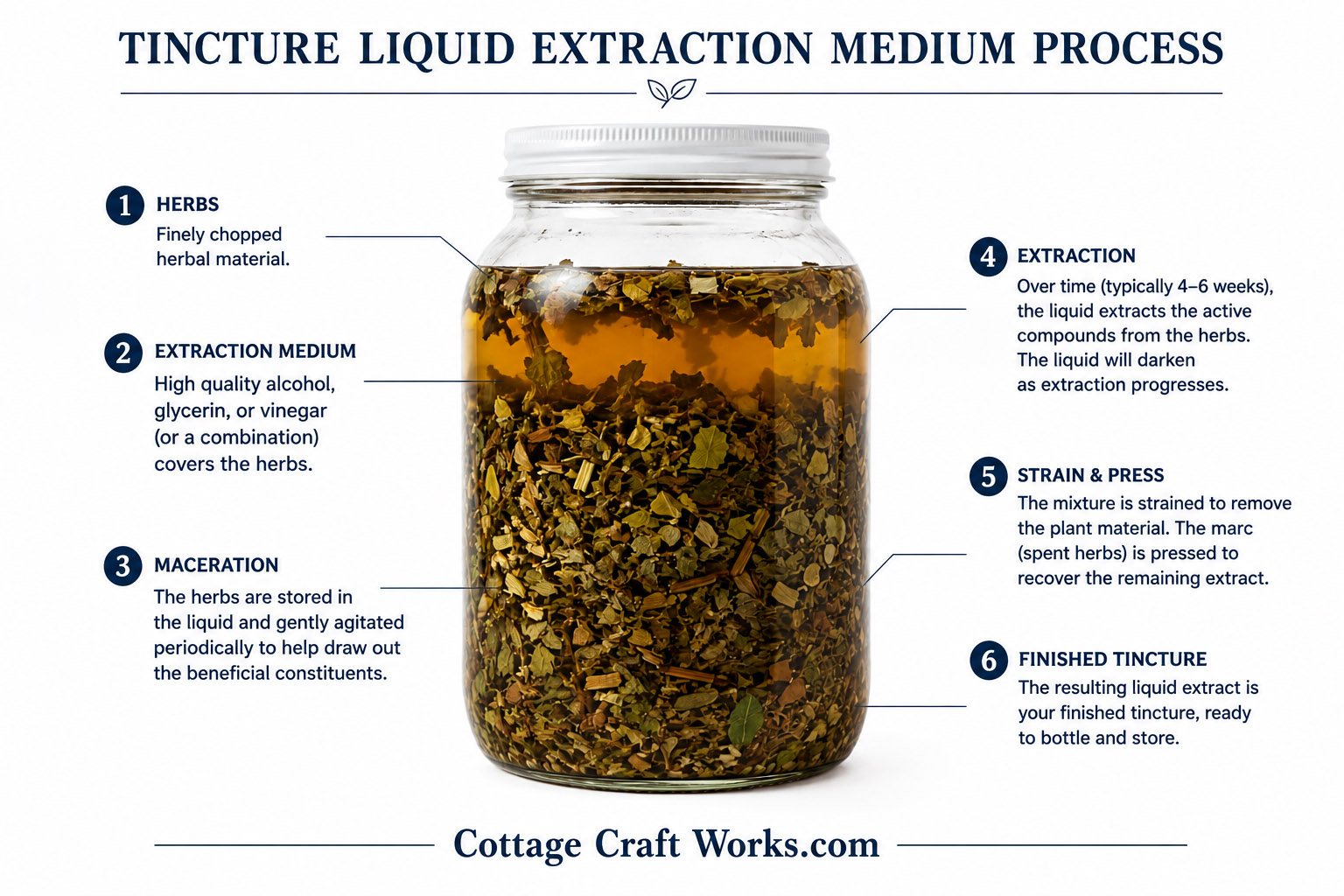
After an herbal tincture or botanical extract has completed maceration, the liquid must be separated from the saturated plant material, known as the marc.
Gravity straining removes the freely flowing liquid, but the wet botanical material can continue holding extract between plant particles and within the compressed mass.
For occasional home batches, hand squeezing may be adequate. As batch size, ingredient value, and production frequency increase, mechanical pressing can reduce labor and provide a more controlled method of recovering liquid retained by the marc.
Cottage Craft Works offers hydraulic tincture presses designed for botanical extracts and other pressing applications. The current press line includes various basket capacities and hydraulic force options for home, small-batch, and commercial production.
What Is Tincture Marc?
Marc is the botanical material remaining after the extraction or maceration stage.
During maceration, the botanical material absorbs some of the menstruum while soluble plant constituents migrate into the surrounding liquid. When the extraction period is complete, simply pouring the contents through a strainer separates the free-flowing liquid but does not necessarily remove all liquid retained by the botanical mass.
That distinction is important.
The liquid trapped in the marc contains the extraction medium that has already undergone the same extraction process as the liquid that drained freely.
Gravity Straining
The simplest separation method is gravity.
The mixture is poured through a suitable strainer or filter and allowed to drain.
Gravity straining works well as the first stage because it requires virtually no mechanical force.
Its limitation is equally straightforward:
Gravity only removes liquid that can freely drain from the botanical material.
Once the marc stops dripping, it may still be wet.
Hand Squeezing
Small home batches are often squeezed manually through cloth or a filter bag.
This can be practical when processing only a small amount of botanical material.
As batch size increases, however, hand squeezing becomes:
- physically demanding;
- time-consuming;
- difficult to repeat consistently;
- limited in the amount of pressure that can be applied;
- increasingly impractical for frequent production.
The real production question becomes the one identified in the original Cottage Craft Works resource plan:
How much operator time and finished extract are tied up in every batch?
Mechanical Screw Pressing
A mechanical screw press provides considerably more leverage than squeezing by hand.
The operator turns a screw that progressively compresses the botanical material.
This can be useful for intermediate production, but the operator must still generate the mechanical force and repeatedly turn the screw as the marc compresses.
Hydraulic Pressing
A hydraulic tincture press uses a hydraulic jack to generate compressive force.
Instead of relying primarily on hand strength, hydraulic pressure pushes the pressing plate against the marc in the press basket and filter bag.
As pressure increases, liquid is forced from the compressed botanical material and collected below.
Basic Pressing Process
A general pressing workflow is:
Macerate → gravity drain → load marc → apply pressure gradually → collect extract → increase pressure as appropriate → allow liquid to drain → release pressure → remove spent marc → clean equipment.
Pressure should be applied progressively rather than attempting to compress the material instantly.
The exact procedure depends upon the press, botanical material, filter bag, and extraction medium.
Why Use a Pressing Bag?
A pressing bag helps contain botanical solids while allowing liquid to escape.
Cottage Craft Works currently offers both 60-mesh and finer 160-mesh pressing bags for its presses.
Mesh selection can affect the amount and size of particulate material passing into the collected liquid.
Pressing and final filtration should nevertheless be viewed as separate production stages. A fine-mesh pressing bag does not automatically eliminate all subsequent filtration requirements.
When Does Hydraulic Pressing Make Sense?
A hydraulic press becomes increasingly useful when:
- batches become larger;
- production becomes frequent;
- botanical ingredients become expensive;
- operator time becomes a high cost;
- hand squeezing becomes physically impractical;
- consistent workflow becomes important;
- production is being scaled commercially.
Pressing Does Not Replace Proper Extraction
A tincture press performs a physical separation function.
It does not determine which botanical constituents are extracted.
Extraction chemistry is established earlier through botanical selection, preparation, menstruum, solvent concentration, ratio, temperature where applicable, and extraction method.
The press simply helps separate the resulting liquid from the marc.
Disclaimer
This information is provided for educational purposes only and is not medical, legal, or regulatory advice. Regulations and requirements may change and vary by product, location, and intended use. Commercial producers are responsible for determining and complying with all current federal, state, and local requirements applicable to their products and operations.
Photos

Gravity Draining Liquid 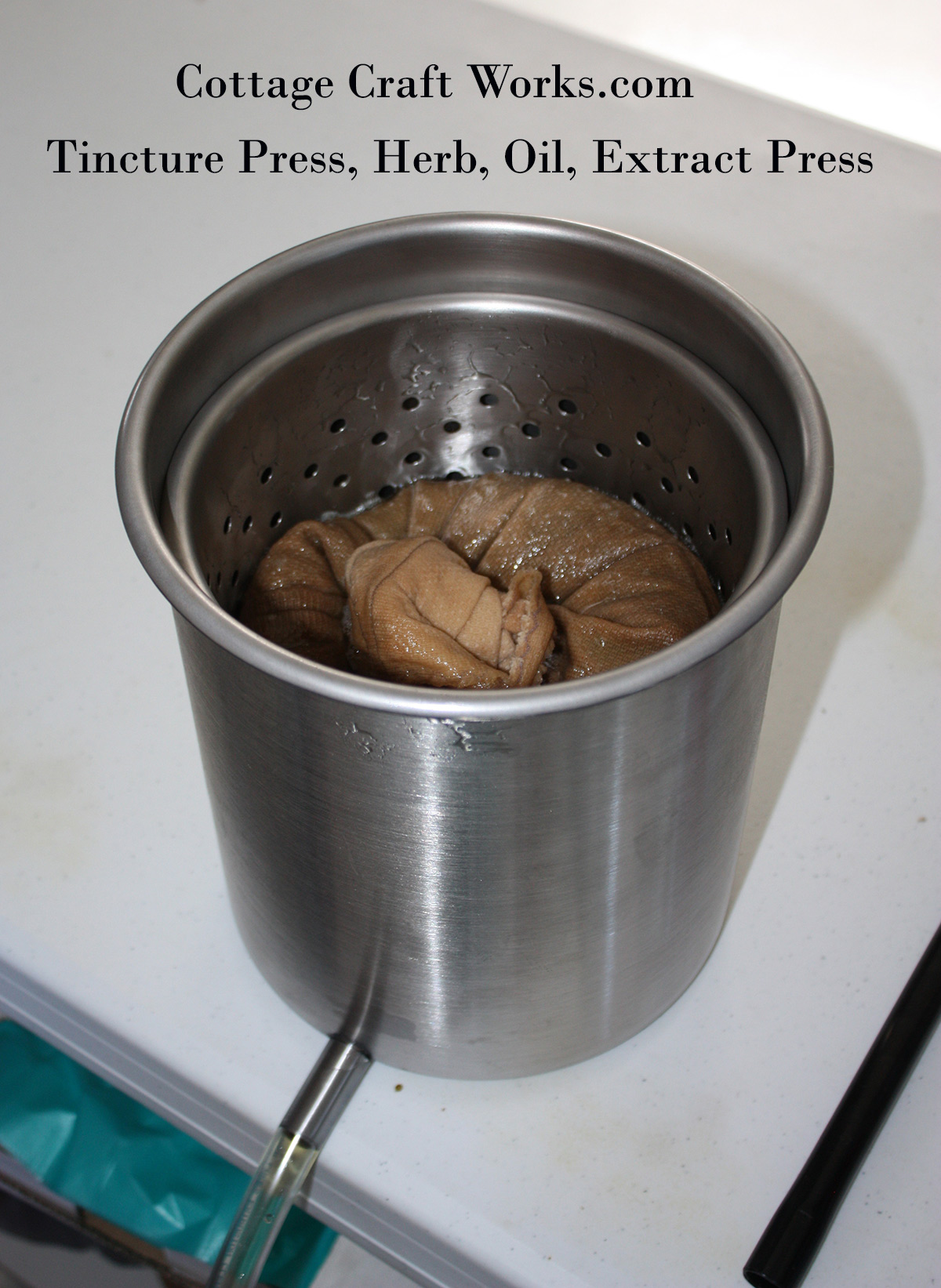
Using a Pressing Bag
Useful links
- Open link
Cottage Craft Works Hydrauilic Presses