


Article
How Herb & Berry Farmers Can Turn Botanical Byproducts Into Tincture Income
Can herb and berry farmers use processing byproducts to create tinctures and another revenue stream?
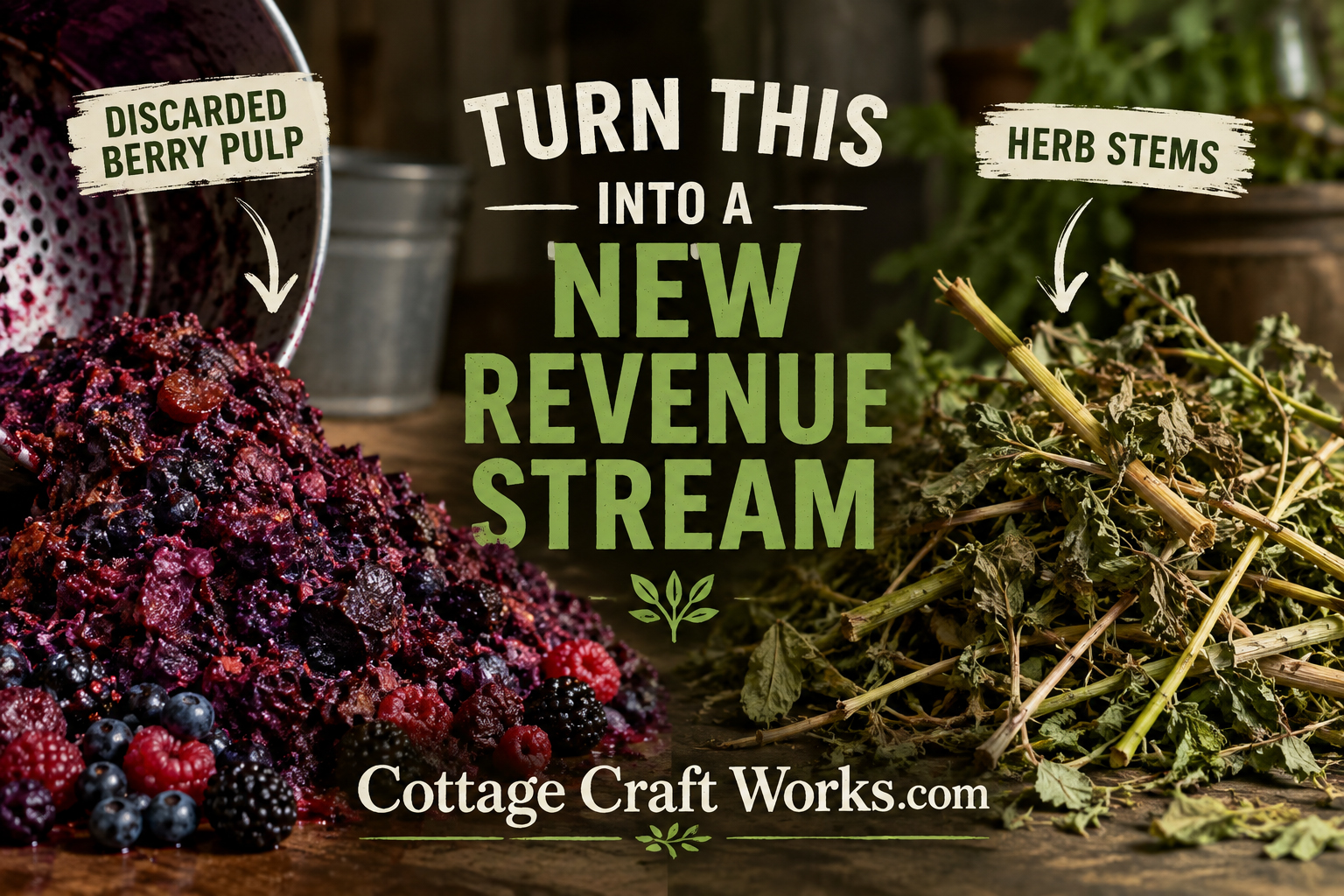
Already growing herbs, botanicals, berries, or fruit? Tincture production may provide an opportunity to create a second value-added revenue stream from suitable plant material generated by your existing operation.
Dried-herb processing can leave stems and other separated botanical material. Berry and fruit operations may also have suitable secondary material that is underutilized. When the particular plant and plant part are appropriate for extraction, some of this material can potentially become the raw material for tinctures and botanical extracts.
Instead of purchasing all of your ingredients from outside suppliers, you may already be growing part of your next product line.
Turn What You Grow Into Another Farm Revenue Stream
For many herb and berry growers, the first question about starting a tincture business shouldn't be:
“Where can I buy herbs to make tinctures?”
It should be:
“What are we already growing that could support another value-added product?”
Herb farms, berry farms, orchards, market gardens, and botanical processors already invest in land, plants, harvesting, labor, irrigation, equipment, and processing. The primary crop may be sold fresh, dried, frozen, pressed into juice, or incorporated into another product.
But what happens to the suitable plant material left after that primary product is made?
Some of it may have little commercial value in its present form. Some may routinely be composted or discarded.
That creates an interesting opportunity.
When a particular botanical and plant part are appropriate for extraction, tincture production may allow a grower to transform suitable secondary botanical material into an entirely different value-added product.
One Harvest. Multiple Potential Products.
Consider the basic concept:
Grow → Harvest → Primary Product → Recover Suitable Secondary Material → Macerate → Press → Filter → Bottle → Additional Product
Instead of evaluating profitability solely by how much dried herb, fresh fruit, or juice can be produced from an acre, growers can begin asking how many marketable products can potentially be developed from the same harvest.
Dried Herb Growers May Already Have Tincture Raw Material
Dried-herb production is a particularly interesting example.
Leaves, flowers, and other desirable portions of an herb may be separated for packaging and sale. Stems and other plant material can have substantially less value in a packaged dried-herb product and may therefore be removed during processing.
That doesn't necessarily mean the separated material has no value.
Depending upon the botanical, the stem or another separated plant portion may still contain extractable constituents. If that particular plant part is appropriate for the intended product, it may potentially be chopped or milled and macerated in an appropriate extraction solvent.
After maceration, a hydraulic tincture press can be used to separate the liquid extract from the fibrous botanical material and recover liquid that would otherwise remain trapped within the plant mass.
The result is a fundamentally different way of looking at the material:
It isn't automatically waste simply because it isn't desirable in a package of dried herbs.
Berry and Fruit Growers Have Similar Opportunities
Berry farms, orchards, vineyards, and other fruit producers can look at their operations in much the same way.
Fruit may already be sold through several channels:
Fresh fruit → frozen fruit → preserves → juice → syrups → other value-added products
Botanical extraction may represent another potential branch.
Depending upon the fruit or berry, intended product, and appropriate plant material, a producer may be able to evaluate suitable secondary material generated during existing processing for use in botanical extracts.
This is especially interesting for operations already pressing fruit or berries.
The important question becomes:
What usable botanical material are we currently producing that doesn't have a profitable destination?
Don't Call It “Waste” Until You Know What It Is Worth
Agricultural businesses have traditionally looked for ways to increase the value produced from each acre.
Tincture and botanical extraction can extend that concept.
A material with little value in one production process might have considerably more value when converted into another product.
That makes it useful to divide the harvest into three categories:
|
Material |
Current Use |
Potential Opportunity |
|
Premium crop material |
Primary retail product |
Continue highest-value use |
|
Secondary usable material |
Low-value sale, compost, or disposal |
Evaluate for extraction |
|
Unsuitable material |
Spoiled, contaminated, unsafe, or inappropriate plant parts |
Do not use for tincture production |
The objective is not to turn agricultural waste into something consumable regardless of its condition.
The opportunity is to identify clean, traceable, suitable botanical material before it becomes waste and preserve it as a potential ingredient.
The Economics Can Be Very Different for an Existing Grower
Someone starting a tincture company without an agricultural operation may need to purchase nearly every botanical ingredient.
That raw-material cost becomes part of every bottle produced.
An established grower has a different starting point.
The farm has already incurred many of the costs required to produce the crop. If suitable secondary botanical material can be captured from an existing process, its incremental acquisition cost can be substantially different from purchasing the same botanical material from an outside supplier.
However, that does not make the finished tincture free to produce.
Growers still need to account for:
- Additional harvesting and handling
- Cleaning and preparation
- Milling or chopping when appropriate
- Extraction solvent
- Maceration containers
- Pressing equipment
- Filtration
- Labor
- Cleaning and sanitation
- Testing and quality controls where applicable
- Bottles and closures
- Labels and packaging
- Storage
- Regulatory compliance
- Marketing and distribution
The business opportunity comes from increasing the value obtained from an existing crop, not from assuming there are no production costs.
A Tincture Press Can Become Farm Processing Equipment
A hydraulic tincture press is particularly relevant when extracting fibrous botanical material.
After herbs or other botanicals have been macerated, simply draining the material can leave valuable liquid trapped within the plant mass.
Pressing mechanically separates additional extract from the spent botanical material.
For an agricultural producer, this means a tincture press can be viewed as more than equipment for a traditional herbalist.
It can become another piece of value-added agricultural processing equipment.
That opens the potential market well beyond dedicated tincture manufacturers to:
Herb farms • Berry farms • Orchards • Botanical growers • Market farms • Juice processors • Dried-herb businesses • Specialty crop farms • Small agricultural processors
Start by Auditing What Your Farm Already Produces
Before purchasing ingredients for a new tincture operation, walk through your existing production process.
Ask:
What do we grow?
List each herb, botanical, berry, and fruit crop.
What is our primary product?
Fresh produce, dried herbs, juice, preserves, frozen fruit, etc.
What gets separated during processing?
Stems, leaves, fruit material, berries, trimmings, or other secondary plant material.
Why are we currently discarding it?
Is it truly unusable, or does it simply have little value in the primary product?
Is that particular plant part appropriate for extraction?
This must be established individually for each botanical.
Can it be kept clean and traceable?
Material intended for extraction should be treated as a potential ingredient from the beginning.
What would it cost to turn it into another product?
Calculate the additional solvent, labor, pressing, filtration, packaging, sanitation, testing, regulatory, and marketing expenses.
What is the potential finished-product value?
That last comparison determines whether the opportunity makes economic sense.
Capture the Material Before It Becomes Waste
This distinction is important for commercial producers.
Material shouldn't be swept up at the end of a processing day and suddenly reclassified as a tincture ingredient.
If a farm determines that a particular secondary botanical material has potential value, it should become part of the production plan.
That means establishing procedures for:
Identification → Separation → Handling → Lot Traceability → Storage → Extraction
Once secondary material is going to become an ingredient in another commercial product, it needs to be handled accordingly.
Not Every Plant Part Belongs in a Tincture
A leaf, stem, root, flower, seed, bark, berry, and fruit from the same plant are not necessarily interchangeable.
The concentration and composition of plant constituents can differ considerably between plant parts. Some portions may be appropriate for a particular extraction while others may be unsuitable or potentially unsafe.
Likewise, material that is moldy, spoiled, contaminated, improperly stored, or otherwise unsuitable should never be “rescued” by putting it into an extraction process.
Extraction does not turn poor-quality botanical material into good-quality botanical material.
Commercial producers should establish the identity, appropriate plant part, condition, intended use, and suitable extraction method for each botanical before developing a product.
From Farm Byproduct to Value-Added Product
For the right agricultural operation, tincture production presents an intriguing question:
How much more value can you produce from a crop you are already growing?
A grower doesn't necessarily need another field or another crop to create another source of revenue.
The opportunity may already be coming through the processing room every harvest.
Identifying suitable secondary botanical material, properly preserving it, developing an appropriate extraction process, and adding pressing and filtration equipment may enable an existing agricultural business to explore an entirely new category of value-added products.
That is the real opportunity:
Grow once. Evaluate every suitable part of the harvest. Create additional value where it makes economic and regulatory sense.
Disclaimer
This information is provided for educational purposes only and is not medical, legal, or regulatory advice. Regulations and requirements may change and vary by product, location, and intended use. Commercial producers are responsible for determining and complying with all current federal, state, and local requirements applicable to their products and operations.
Useful links
- Open link
USA Hydraulic Tincture Presses
