
Article
Commercial Tincture Production: How to Scale Herbal Extraction from Small Batches
How do I scale herbal tincture production from small batches to commercial production?
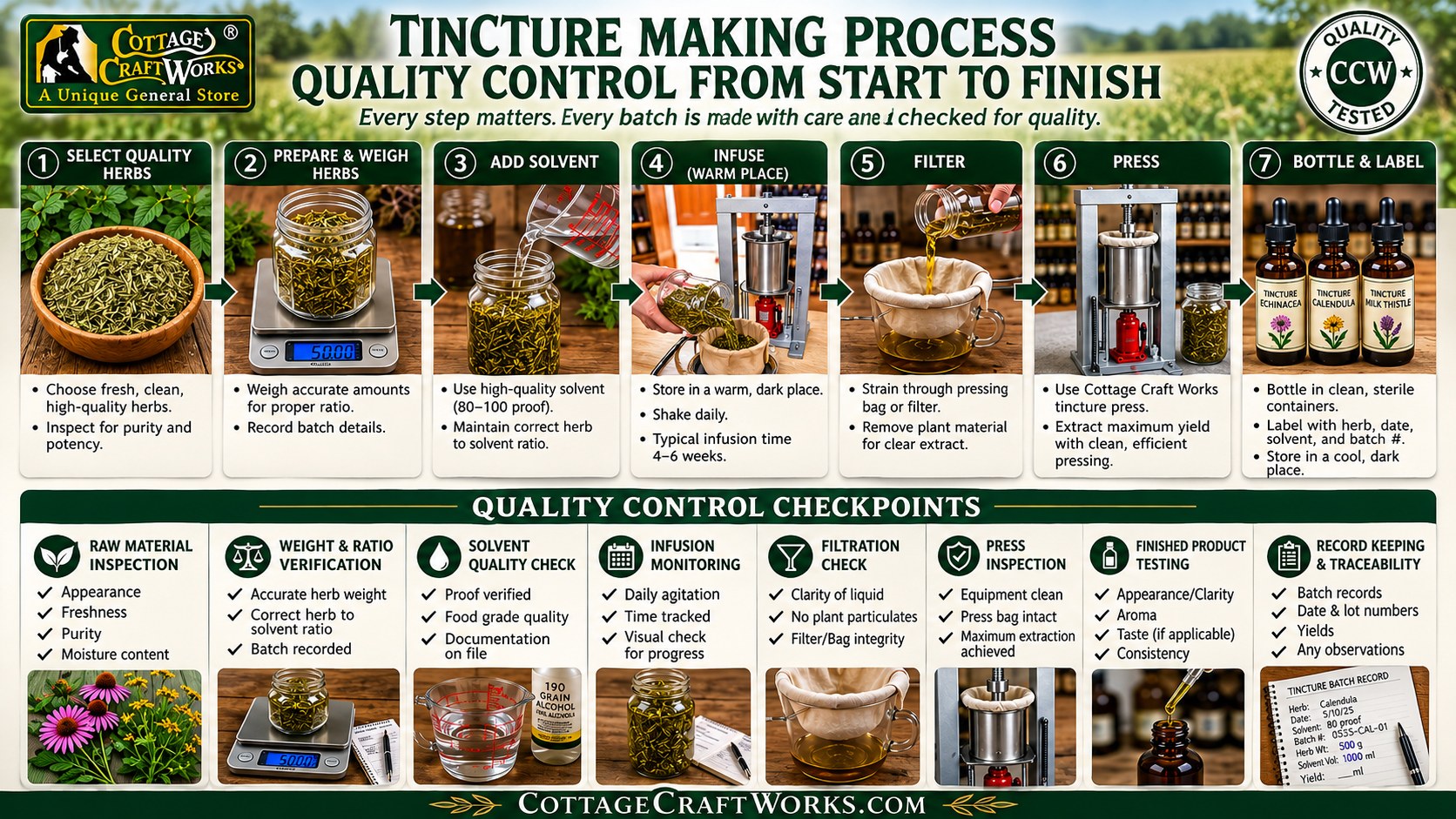
Standardize the extraction process first, measure batch volume and labor, identify the production bottleneck, and then match equipment to the workflow. As volume grows, hydraulic pressing, filtration, bottling equipment, ingredient traceability, batch records, inventory planning and quality-control procedures become increasingly important.

Scaling tincture production does not simply mean using a larger jar.
As production increases, the limiting factor can move from extraction volume to labor, pressing, filtration, bottling, storage, or documentation.
A scalable operation treats the complete workflow as a connected system:
Ingredients → weighing → extraction → maceration → draining → pressing → filtration → bottling → labeling → storage → records.
Why Small-Batch Methods Eventually Become Bottlenecks
A home producer can spend considerable time manually handling a few jars without seriously affecting output.
At commercial volume, every repetitive step multiplies.
Ten minutes of unnecessary handling, repeated across dozens of batches, becomes a real production cost.
Step 1 — Standardize Before Scaling
Do not enlarge an inconsistent process.
First establish:
- botanical specifications;
- plant part;
- extraction ratio;
- menstruum;
- processing procedure;
- extraction period;
- pressing procedure;
- filtration;
- finished-batch records.
Step 2 — Measure Actual Production
Track:
- botanical weight per batch;
- menstruum volume;
- extraction-vessel capacity;
- marc volume;
- pressing time;
- filtration time;
- finished liquid volume;
- bottles produced;
- labor hours.
Without measurements, the operator may purchase equipment for the wrong bottleneck.
Step 3 — Find the Bottleneck
Ask:
What step prevents us from producing the next batch?
It may be:
- insufficient extraction vessels;
- slow hand pressing;
- small press capacity;
- slow filtration;
- manual bottle filling;
- insufficient storage;
- labeling;
- cleaning;
- documentation.
Step 4 — Increase Batch Size Carefully
Larger batches can reduce setup time per finished bottle, but they also increase the consequences of a production error.
Scale documented processes rather than improvising.
Step 5 — Mechanize Pressing
Pressing is an obvious place where manual production can become inefficient.
At small scale:
strain → hand squeeze.
At increasing scale:
drain → load pressing bag → hydraulic press → collect → unload.
Cottage Craft Works' current press offerings include hydraulic options and replaceable pressing bags intended for this stage of botanical processing.
Step 6 — Match Press Capacity to Extraction Capacity
A press that is much smaller than the batches coming out of maceration requires repeated loading.
A press dramatically larger than normal production may leave capacity unused.
Coordinate:
Extraction-vessel size → amount of wet marc → press-basket capacity → batches per production day.
Step 7 — Improve Material Flow
Arrange production to minimize unnecessary movement.
An efficient conceptual flow is:
Raw-material storage → weighing/preparation → extraction → draining → pressing → filtration → bottling → finished storage.
Moving material backward and forward through the same workspace wastes time and can complicate sanitation.
Step 8 — Separate Production From Inventory Planning
A business needs sufficient:
- botanicals;
- extraction medium;
- bottles;
- caps/droppers;
- labels;
- pressing bags;
- packaging
to support the production schedule.
Running out of a low-cost component such as a closure can stop an otherwise expensive batch from reaching saleable inventory.
Step 9 — Calculate Yield
Record both the starting inputs and final saleable output.
For business purposes, a useful question is:
How many saleable bottles did this batch actually produce?
That connects extraction efficiency directly to cost accounting.
Step 10 — Calculate Labor per Batch
Track hands-on time separately from passive maceration time.
A batch may extract for weeks without consuming significant labor during most of that period.
Pressing, filtration, filling, labeling, and cleanup are distinct: each requires operator time.
Those stages are often where equipment investment produces the most visible workflow benefit.
Step 11 — Determine When Equipment Pays
Do not justify equipment solely by saying it is faster.
Estimate:
Labor saved per batch × batches per year = annual labor savings.
Then consider other operational benefits such as capacity, consistency, and reduced repetitive manual work.
Step 12 — Build Quality Control Into Growth
Greater output increases the importance of:
- lot tracking;
- written procedures;
- sanitation;
- equipment maintenance;
- production records;
- deviation records;
- finished-lot identification.
The goal is to make a larger operation more controlled, not merely larger.
Disclaimer
This information is provided for educational purposes only and is not medical, legal, or regulatory advice. Regulations and requirements may change and vary by product, location, and intended use. Commercial producers are responsible for determining and complying with all current federal, state, and local requirements applicable to their products and operations.
Useful links
- Open link
USA Hydraulic Presses